

Roughly eleven years ago, Anna Yona founded Wildling Shoes together with her husband – originally because their three kids, who had grown up running barefoot in Tel Aviv, couldn’t find suitable shoes in Germany. Today Wildling sells around half a million pairs of minimal shoes per year, in sizes 18 to 48, with about 80 employees – fully D2C, no retail, no Amazon, no investors.
In episode 174 of Happy Bootstrapping, Anna walks us through how they financed the start with a KfW founder loan and a crowdfunding campaign, how an undetected post-pandemic growth slowdown led the company through two rounds of layoffs – and why they want to keep going exactly like this.
This is a summary of Episode 174 of the “Happy Bootstrapping” Podcast (German).
From Tel Aviv to the Oberbergisches Region: A Family Idea Becomes a Company
Anna studied in Tel Aviv, met her husband – a sports therapist – there, and lived in Israel for twelve years in total. Their three kids were born there and grew up barefoot, partly because Anna’s husband is professionally focused on mobility and gait. In 2013 the family moved back to Germany, settling near Cologne.
When winter came, the kids needed shoes – and nothing on the market matched what they were used to. The simple thought “then we’ll just make a better shoe” turned into eighteen months of groundwork: a business plan, a designer found online, materials research, a shoemaking workshop they won in Pirmasens, factories sourced in Portugal. In parallel, the founding couple deliberately registered as unemployed to be able to focus entirely on building the company.
“Looking back, I think it was actually pretty smart that there was no plan B.”
€150,000 Loan, ~€100,000 in Crowdfunding – and a Community That Was Already There
Wildling financed the start with a KfW founder loan (the ERP-Startgeld program, up to €100,000 per founding person) – Anna and her husband took out €150,000. The money went entirely into product development and preparation; the molds for the outsoles alone cost nearly €3,000 per size. In parallel, Anna built a community on Facebook, especially in mompreneur groups.
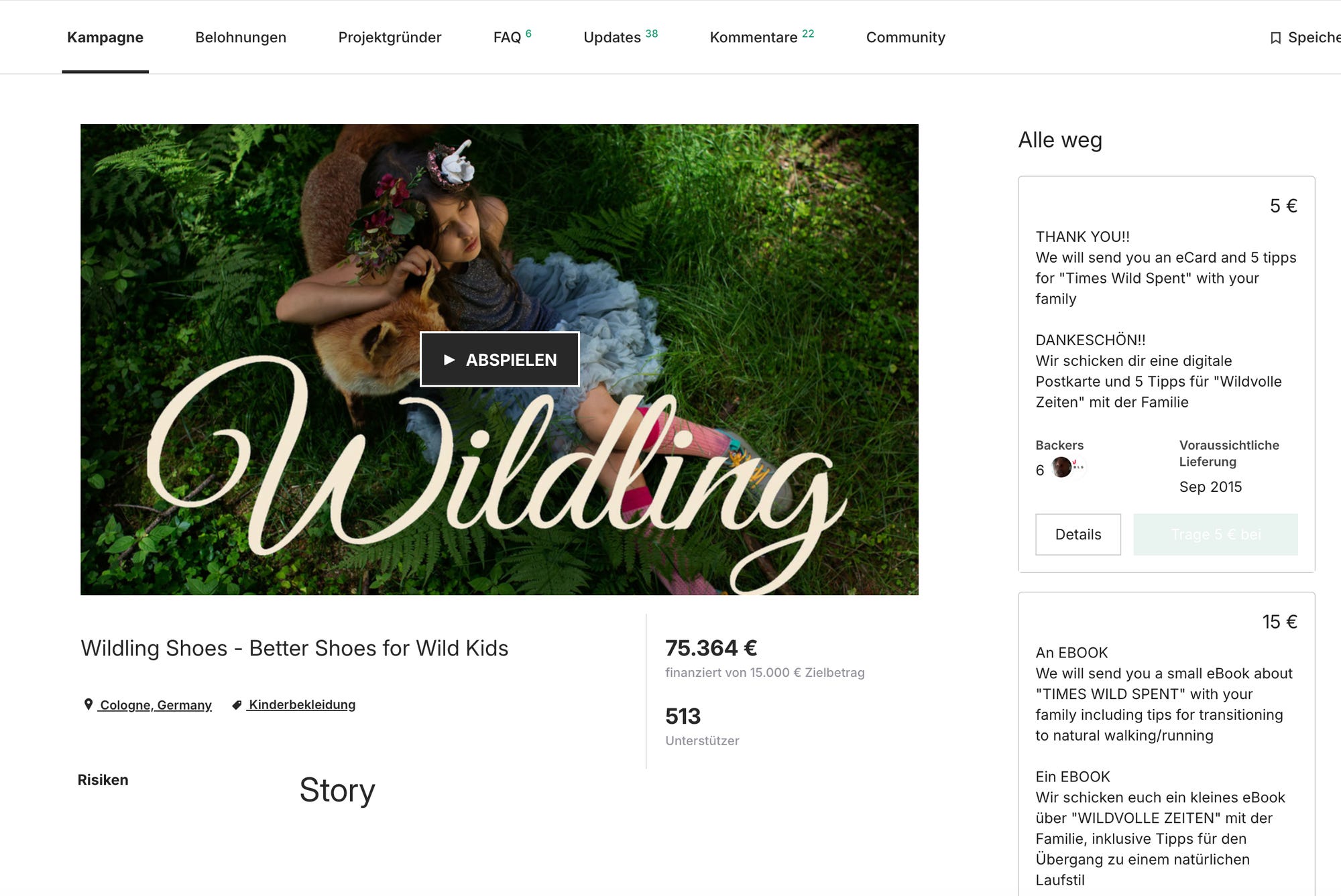
By the time the crowdfunding campaign launched, around 1,000 interested people were already in the wings. The €12,500 goal was hit in 24 hours; in the end the campaign brought in €75,000, and another €30,000 came through pre-orders – about €100,000 in total. The first major production run was prefinanced this way.
It didn’t go smoothly, though: an extra material they’d sewn in for water resistance bled heavily when wet – socks, feet and skin suddenly turned blue. A near-disaster that only ended well because the community saw itself as part of the journey: most customers waited for a corrected pair or took a discount, and Wildling sold even the defective stock in the end.
Deliberately No Retail, Deliberately No Amazon
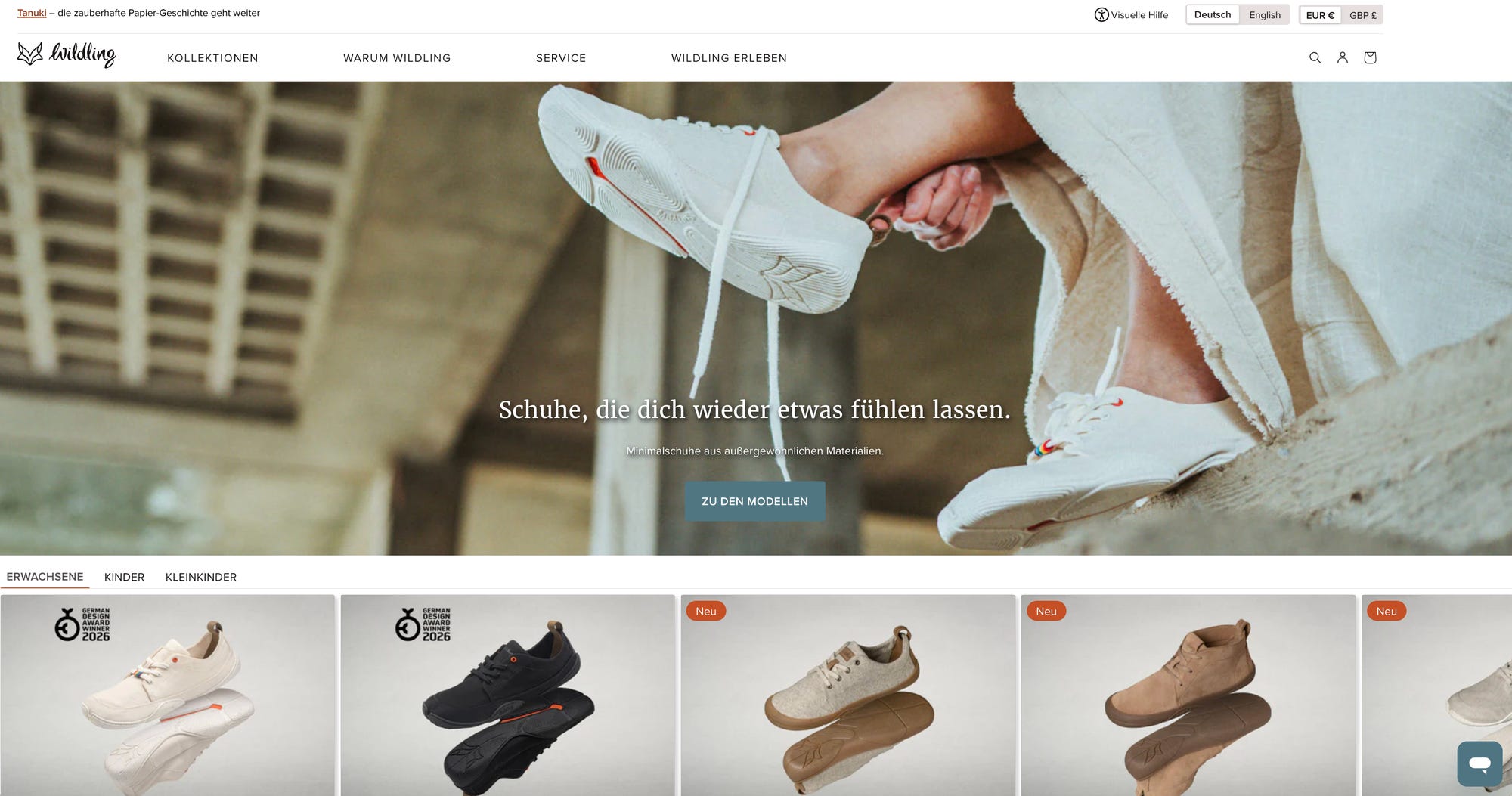
Wildling sells almost exclusively direct to this day: through its own webshop and a small store in Engelskirchen. Initially there was simply no other option, because they were constantly sold out. But even as volumes grew, Anna stayed consistent: the high-quality materials and complex manufacturing make the product expensive, and pricing in an additional retail margin would have been impossible.
On top of that, she’s clear about her position: Amazon is not the right environment for Wildling. She openly acknowledges in the interview that this stubbornness – no brand bidding on Google, barely any paid performance ads, no marketplace presence – has cost the company significant revenue to competitors over the years. Accepted, not regretted.
“Our production costs were always relatively high. We just couldn’t have priced in a retail margin on top of that.”
The Growth Slowdown They Missed – and Two Rounds of Layoffs
For years, Wildling grew almost entirely through word of mouth. Every pair shipped brought one to two new customers; revenue tripled from one year to the next at times. Paid marketing was barely a thing – and that’s exactly what became the trap during the pandemic. When people don’t meet anymore, they don’t talk about their shoes either. Exponential growth flattened sharply, and Wildling took too long to understand what was happening.
People kept being hired into a curve that was already bending the other way – at one point the team was just under 300. What followed were two rounds of layoffs: in early 2023, around 40 people left the company; in early 2025, the team was reduced to today’s roughly 80 employees. In retrospect, Anna says, the hard cut should have happened in the first round rather than being spread out over two.
“The first thing that had to happen was a mindset shift – away from ‘we throw a person at every problem.’”
Routine Allergy, Family Business, and the Long Game
Wildling has been remote-first from day one – out of life circumstances, not strategy. Anna’s husband is her co-founder, her father runs the recycling initiative, her sister handles photography, and her son is now doing an apprenticeship in the company. The line between family and business is fluid – sometimes exhausting, often beautiful.
At the end of 2024, the family took a seven-week break in Costa Rica. Anna talks openly about her “routine allergy,” about how her creative ideas usually come during downtime, and about deliberately building a setup in which others run the day-to-day. Her plan: at least another ten years of Wildling – no exit, no investors, no rush.
The full episode is now also on YouTube (German only):
Key Takeaways
Wildling sells around 500,000 pairs of shoes per year, in sizes 18 to 48, with about 80 employees.
The start was financed by a KfW founder loan (€150,000) and a crowdfunding campaign that hit its €12,500 goal in 24 hours and ended at ~€100,000 including pre-orders.
D2C only: no retail, no Amazon, barely any performance marketing – for both economic and ethical reasons.
The pandemic growth slowdown was recognized too late; the team shrank from nearly 300 to 80 in two rounds of layoffs.
Purely in terms of business output, the 80-person team delivers what the company once did with 260 – with almost no use of AI.
Lessons for Founders
Having no plan B can be a powerful focus driver – when personality and family situation allow for it.
Building a community before the start is more valuable than any crowdfunding mechanic itself.
High product costs and a retail margin are often incompatible – D2C may be the only sensible option.
Don’t paper over growth issues with more headcount – the mindset shift has to land before the next hire.
With restructuring, one hard cut beats two salami slices – even when it feels radical in the moment.
Happy Bootstrapping is a German podcast where I interview bootstrapped founders, indie hackers, and solopreneurs about their startup journeys.
Over the years, I’ve connected with many successful entrepreneurs who have built e-commerce shops, SaaS platforms, mobile apps, content businesses, or hybrid models.
Furthermore I am a bootstrapper myself and growing my DevOps-as-a-Sercice and Web Operations Company “We Manage”.