

Sven Feliks is 33 years old, born near Stuttgart, and spent 14 years working at Mercedes. Last year, he took the severance package and went full-time on his startup visito.me – a SaaS platform that offers restaurants digital menus, reservation systems, ordering and payment features, all from a single platform.
He founded the company back in 2020 during Covid together with three friends from university. Currently, Visito has 35 paying customers and 154 restaurants on the platform in total.
This is a summary of Episode 161 of the “Happy Bootstrapping” Podcast (German).
From a Covid Night Shift to the First Prototype
Visito’s story actually starts with a completely different product. Sven and his three co-founders Alex, Dennis and Flo had built a social media app called SWOT during their studies – a platform where users could let their community vote on decisions. The app had around 10,000 users but generated zero revenue. When Covid hit and restaurants suddenly had to document guest contact details, an acquaintance called Sven and asked if there was a digital solution.
On a Friday evening at 5 PM, Sven called his co-founders and told them to drop everything – by 3 AM the first functional prototype was ready. At 9 AM, Sven was already walking through Stuttgart selling the system to restaurant owners. He negotiated prices like on a bazaar – €80 at the first place, €40 at the next. His co-founders nicknamed him the “camel trader”.
“Friday evening, 5 or 6 PM, I called my guys and said: Drop everything, we’re building something new. By 3 AM the first prototype was ready.”
The Product and Business Model
Visito positions itself as the “Amazon Prime for restaurants” – a platform that bundles as many digital tools as possible in one place. Core features include a multilingual digital menu with filter options, a reservation system, digital ordering and payment, loyalty stamp cards, internal pop-up advertising, and most recently an AI voice agent for phone reservations.
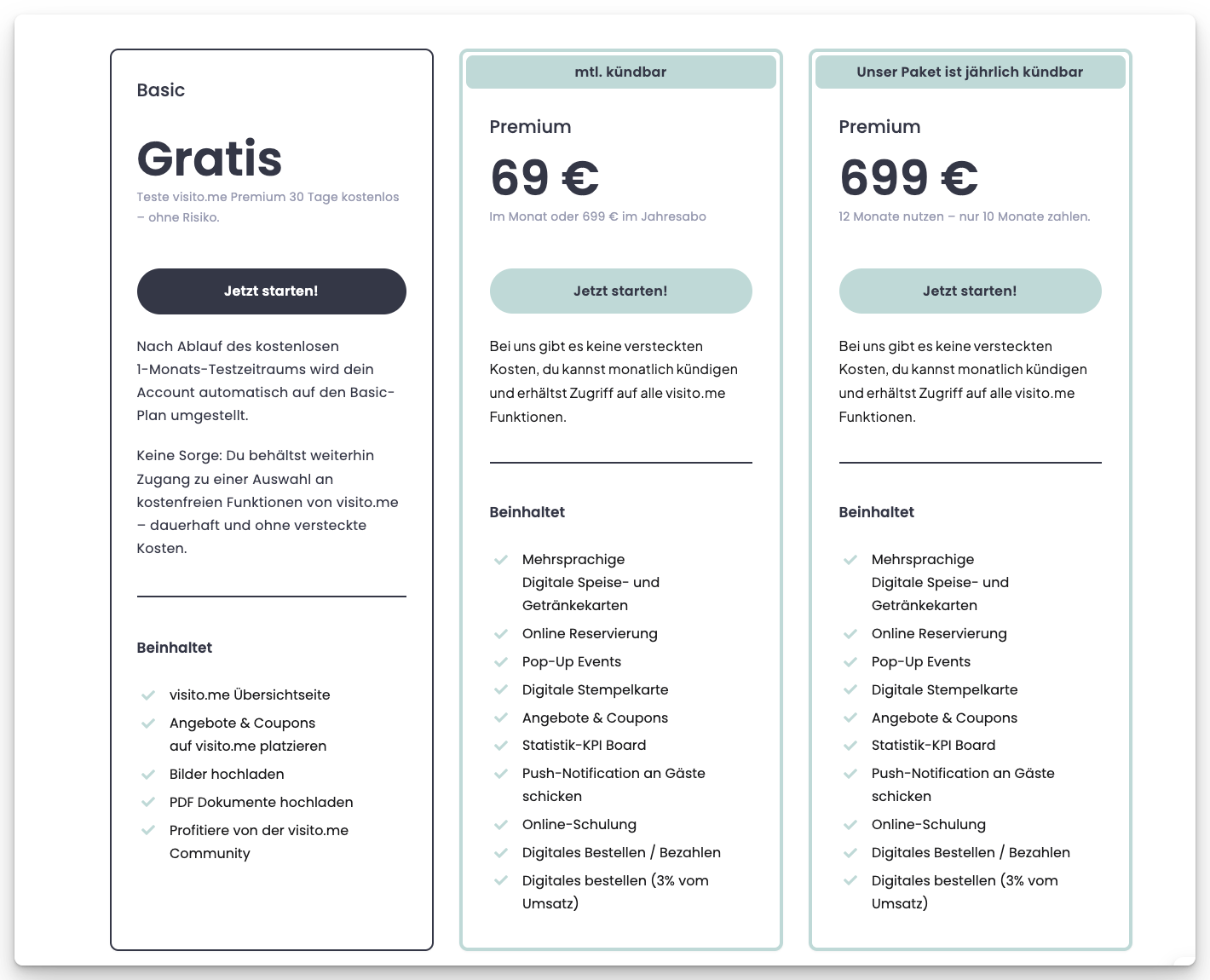
The pricing is deliberately simple: there’s a free Basic version with a profile and link-tree functionality, plus a Premium package for €69 per month or €699 per year. Currently, around 80 percent of customers pay monthly, while 20 percent use the annual plan. For comparison: one restaurant owner told Sven he paid €10,000 per year to Lieferando (Germany’s dominant food delivery platform) alone – with Visito, even including transaction fees, costs never come anywhere close to that amount.
“We want to make IT affordable and become the Amazon Prime for restaurants.”
Marketing and Growth
At Visito, Sven is the “junior for everything” – sales, marketing, onboarding, support. His three co-founders still work full-time in their day jobs and handle the development. Sales run on a mix of old-school door-to-door visits and social media ads. In Hamburg, Sven printed 200 pitch decks and walked from restaurant to restaurant. Out of 200, five showed interest – the time investment was high, the return modest.
Referrals work much better. One customer near Berlin’s Alexanderplatz, who switched from Open Table to Visito, immediately offered to bring in five or six new customers from his network. Sven also organized a hackathon with the City of Stuttgart and DEHOGA (Germany’s hotel and restaurant association), which attracted 37 participants and already produced concrete leads and potential team members.
The Mercedes Severance as a Launchpad
After 14 years at Mercedes, Sven used the severance package as his personal runway. The severance was a standardized process based on years of service and age. According to Sven, the money won’t last five years, but with his wife’s support, he’s given himself a window of about nine months. All revenue that Visito generates goes straight back into advertising – none of the four founders currently pay themselves a salary.
“If someone asks me in ten years whether I dared to do everything, I can now say with a clear conscience: Yes.”
What I Learned in This Interview
Gastro SaaS requires patience: The market is huge – 35,000 restaurants open and close annually in Germany – but the willingness to digitize isn’t universal yet. After five years, Sven has 35 paying customers and is fighting for every single one.
Referrals beat cold outreach: 200 door-to-door visits in Hamburg generated five leads. A single satisfied customer in Berlin offered to bring in several new clients. In the restaurant business, authentic recommendations are worth their weight in gold.
Leaving a corporate job needs a clear timeline: Sven set a time window with his wife, lives deliberately frugally off his severance, and has a clear target: 200 to 250 customers by year-end. There is no Plan B on purpose.
Learnings for Founders
Use a crisis as a catalyst: The sudden need for digital contact tracing during Covid opened the door to the restaurant industry – Sven and his team built a prototype overnight and were selling it the next morning.
Keep the pricing model simple: A flat fee instead of per-reservation transaction costs clearly differentiates Visito from Open Table and Lieferando – and is instantly understandable for restaurant owners.
Let customer feedback drive your product: Visito builds features that restaurants actually request – from the AI voice agent to pop-up ads. The customers are essentially the product owners of the backlog.
Founder team harmony matters: Four friends, four different minds, but shared decisions – Sven emphasizes that he argues less with his co-founders than with some of his friends.
Bootstrapping means reinvesting: All revenue flows back into the company. None of the founders currently pay themselves a salary – the focus is entirely on growth.
The full episode is also on YouTube (german only):
Happy Bootstrapping is a German podcast where I interview bootstrapped founders, indie hackers, and solopreneurs about their startup journeys.
Over the years, I’ve connected with many successful entrepreneurs who have built e-commerce shops, SaaS platforms, mobile apps, content businesses, or hybrid models.
Furthermore I am a bootstrapper myself and growing my DevOps-as-a-Sercice and Web Operations Company “We Manage”.