

Filip Mierzwa is the co-founder of STUR, based in Berlin. Together with Simon Köstler-Prada, he makes cast iron pans that are cast, machined and seasoned entirely in Germany. It all started with a blog on which the two of them reviewed other manufacturers’ pans.
This is a summary of Episode 183 of the “Happy Bootstrapping” Podcast (German).
From Affiliate Blog to Their Own Brand
Filip and Simon met while studying e-commerce in Würzburg. In 2016 they launched Pfannenhelden.de, a pan review blog funded through affiliate links. Over the years, something accumulated there that later turned out to be decisive: reach among people who take cookware seriously.
At some point, reviewing turned into the desire to do it better themselves. The model came from the US, where Field Company had launched a cast iron skillet via crowdfunding. Nothing comparable existed in Germany. Filip describes his entry into the category in hindsight:
“I thought to myself, how hard can it be to make a pan? Until we realised: incredibly hard, because we had no idea how something like that is produced.”
The brand name came from a product characteristic: the pan was meant to be stubborn – stur in German – not warping, not wearing out. It is cast by a manufacturer that had previously worked mainly for the automotive industry.
Eighteen Months of Groundwork for a 30-Day Campaign
Before launching, Filip read everything he could find about successful crowdfunding. His key insight contradicts the common assumption that a well-designed project page is enough.
“Most people think – and this is the biggest mistake in crowdfunding – you go to the platform, you put your project up, however nicely designed it is, and there are all these people waiting to back crowdfunding projects. And that’s only partly true.”
So the two built their crowd themselves. For eighteen months they documented the development of the pan, posted in forums such as Grillsportverein and on Reddit, and collected email addresses. Roughly 500 sign-ups grew to 25,000 by the time the campaign started. The existing blog helped considerably.
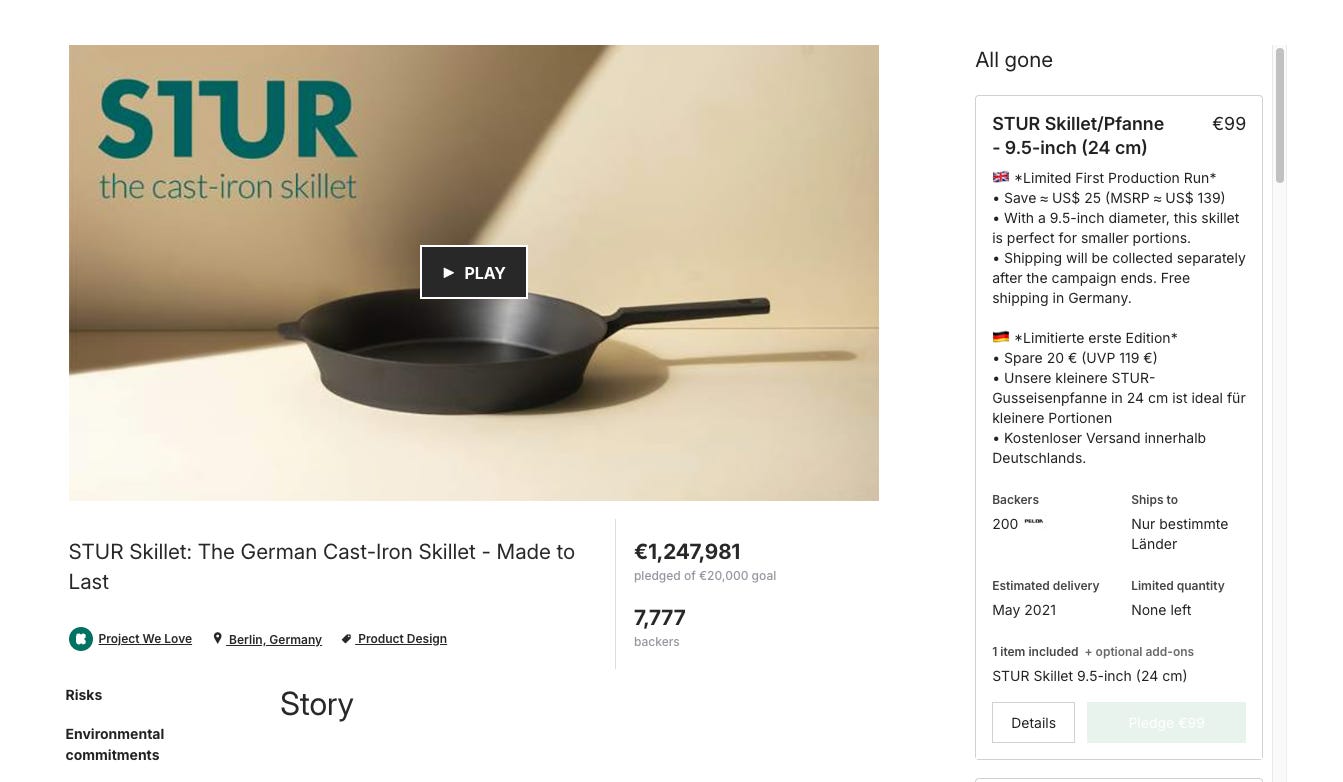
The Kickstarter campaign went live in October 2020. The €20,000 goal was reached after three minutes, €100,000 after thirteen minutes, and by the end of the first day the total had passed €450,000. After 30 days it stood at €1.25 million – more than the two had expected for the entire campaign.
Then the Real Work Began
The money came with an obligation: 18,000 pans had to be produced and shipped while the supply chain for them was still being built. Tooling, procurement, logistics, quality control – all new, all managed in-house. The first backers ended up waiting almost a year for their order, three months longer than announced. The first deliveries in Berlin were made by the team themselves, by cargo bike.
In March 2021, Filip and Simon appeared on “Die Höhle der Löwen”, the German equivalent of Shark Tank – at a point when not a single pan had shipped. Three of the five investors made an offer: €380,000 for 20 to 30 percent. STUR had entered the negotiation at 10 percent and countered with 12.5. No deal materialised. To this day, the company has taken no outside capital.
The Problem With a Product for Life
STUR gives a 50-year warranty on its pans. For customers that is an argument in favour; for growth it is a challenge. Filip puts it plainly:
“So yes, it’s a buy-once product. We want to find new people who don’t know it yet and sell to them.”
The second lever is the product range. There is now accessory equipment, a roaster and, more recently, an olive oil in a squeeze bottle – the first product that actually gets reordered. Here too, validation comes before investment: is it well received, is it reordered, does a custom bottle make sense? The longer-term idea reaches beyond physical products, towards a brand that teaches cooking techniques and brings professional kitchen tools into private homes.
Sales run through the company’s own shop and through Amazon, though at higher prices there than in direct sales. There are no Black Friday discount campaigns; instead, STUR includes an accessory above a certain order value. Filip’s goal for the coming years is clear: to be in one million kitchens by the end of 2030.
What I Learned in the Interview
A community cannot be conjured up on short notice. Those 25,000 email addresses were the result of eighteen months of work plus four years of blogging before that. Exactly this groundwork determines what happens on day one of a campaign.
Crowdfunding success is not yet business success. The €1.25 million was not profit, it was an obligation. The real challenge started after the campaign.
A buy-once product forces a clear growth strategy. Either you constantly win new customers, or you extend the range with products people buy again. STUR does both.
Learnings for Founders
Build your crowd before you need it. Platforms do not bring the backers with them.
Document the development process publicly – it creates a following before there is a product.
Calculate conservatively and plan for the time after launch, not just up to it.
Bring supply chain expertise into the team earlier than seems affordable.
With every new product, test on a small scale first whether it is accepted.
A fair price all year round is more credible than a discount in November.
The full episode is now also on YouTube (German only):
Happy Bootstrapping is a German podcast where I interview bootstrapped founders, indie hackers, and solopreneurs about their startup journeys.
Over the years, I’ve connected with many successful entrepreneurs who have built e-commerce shops, SaaS platforms, mobile apps, content businesses, or hybrid models.
Furthermore I am a bootstrapper myself and growing my DevOps-as-a-Sercice and Web Operations Company “We Manage”.