

Sonnenschmiede: Solar Power for Every Flat, Without Investors
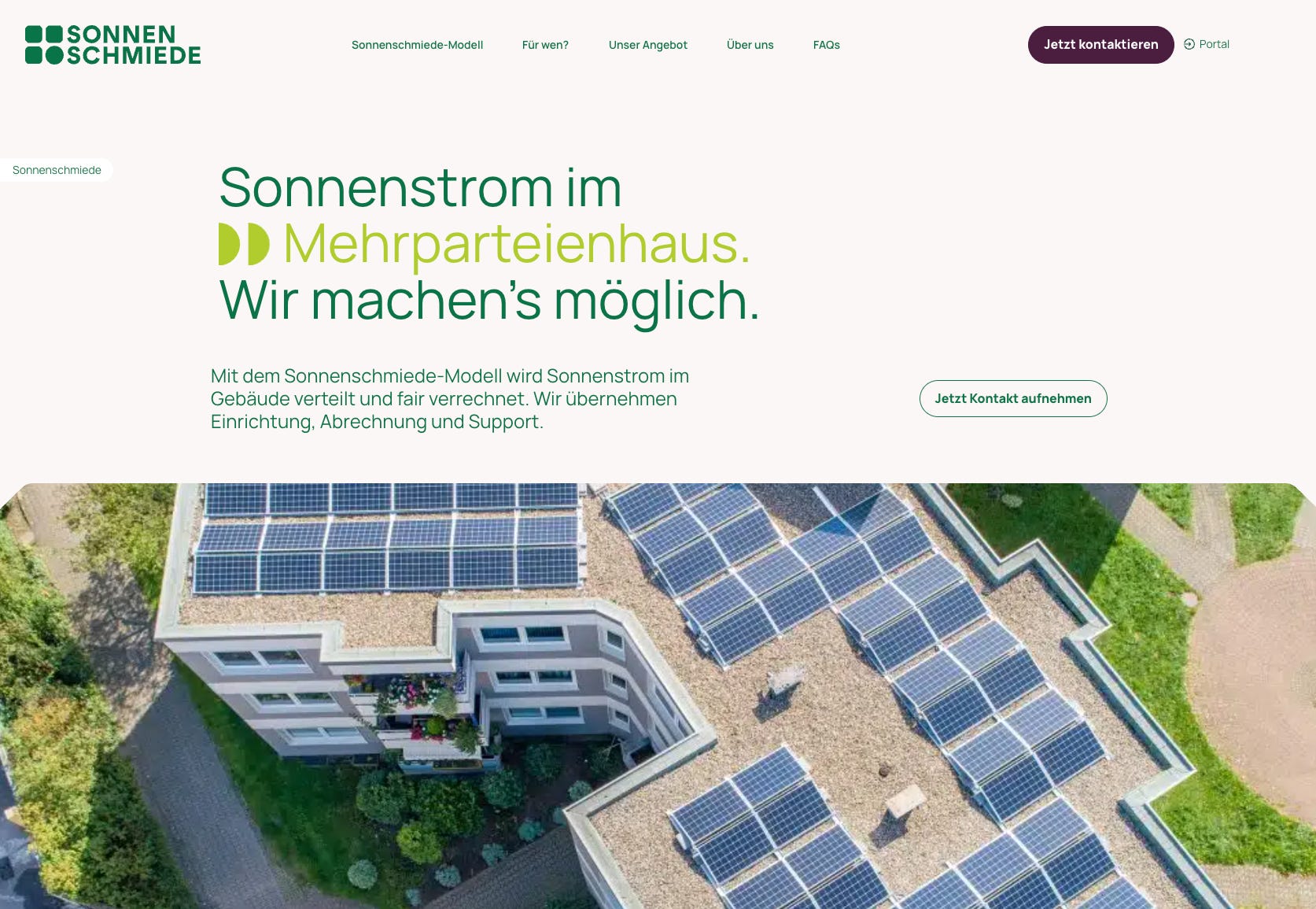
Alexander Hojas and Thomas Auer run Sonnenschmiede in Graz, Austria. They set up energy communities in apartment buildings so that the power from the solar panels on the roof reaches every flat, and afterwards they take care of metering, billing and bookkeeping. With a team of ten, they made almost one million euros in revenue last year, without investors and with hardly any marketing.
This is a summary of Episode 197 of the “Happy Bootstrapping” Podcast (German).
One Roof, Many Meters
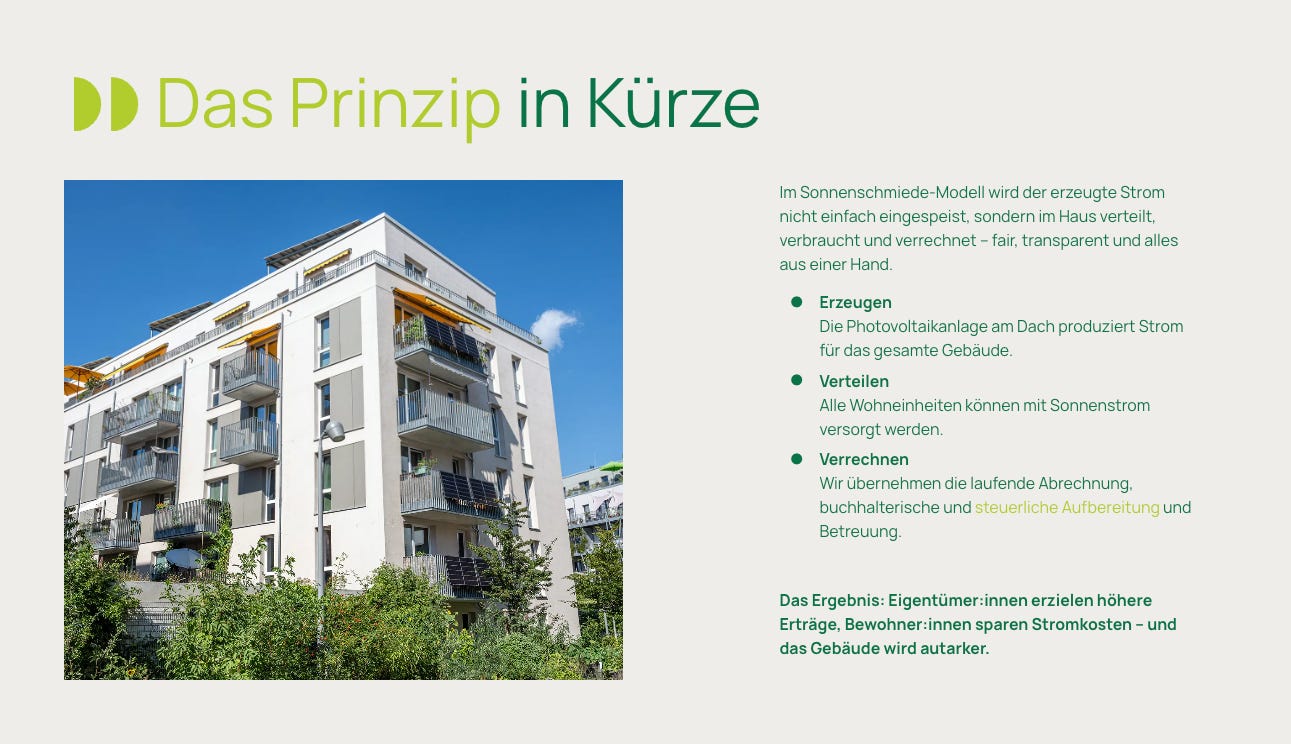
In an apartment building every flat has its own electricity meter, but a solar installation can technically be connected to only one consumer. In a building with ten flats, one household gets the power and nine get nothing. Sonnenschmiede adds an energy community on top, and billing runs through the smart meters that are installed almost everywhere in Austria.
Unlike contracting, the installation stays with the building owners. They also set the tariff for their tenants. Alex and Thomas recommend charging half the market price for the solar power. Landlords still come out ahead: according to Alex, feeding power into the grid earns around 6 cents per kilowatt hour, while selling it inside the building brings 18 to 20 cents.
The company earns money in two ways: one-off fees for project support, then a service fee for metering, billing and tax. At the end of the year the owners receive a fully booked credit note. The fee per project is small, but across many installations it adds up to recurring revenue.
A Beer on the Balcony and a Golden Cage
The idea came from Alex’s parents. They wanted to put solar panels on their apartment building, and the other owners loved the plan. Then the property manager, the grid operator, the tax adviser and the building authority all said no. Alex was annoyed, looked into the market and pitched the idea to Thomas over a beer on the balcony. He did not expect much:
“He’s definitely not leaving his golden cage.” (translated)
Thomas had spent seven years in a corporate banking career and had a small child at home, with a second on the way. A few days later he sent Alex a WhatsApp message saying he could not stop thinking about it. Alex replied within 15 seconds: he had wanted to write the same thing for three days. Thomas resigned and went all in.
For a year the two worked from a rented flat in Vienna without paying themselves a salary. They financed it from Thomas’s savings and from the sale of Alex’s previous company, and later took loans from family and friends. They deliberately set the interest at 7%, because it was risk capital and there was not a single paying customer yet. The first years were repayment-free, and today about 20% is still outstanding.
Startup Speed Meets Real Estate
What the founders underestimated most was time. Alex expected a few months until the first solar power flowed. Then Sonnenschmiede won a pitch with a large housing association, and nine months later only three new installations had been added. The managing director was simply planning for the next ten years.
“Startup time, I think in months, in days. Real estate time, decades.” (translated)
On average a project takes two years from first contact to a finished shared installation. If the panels are already on the roof, it takes three to four months. Usually 70 to 80% of residents take part.
Investors Turned Down, Niche Chosen
Sonnenschmiede won many startup awards in Austria, and the attention brought investors. On paper it is a classic venture case, but the two founders turned down every offer.
“We don’t want to become employees in our own company, we want to be free.” (translated)
Two Austrian competitors have raised larger rounds. Sonnenschmiede sticks to its niche, the apartment building, and according to Alex they win 80% of the tenders from large housing associations. A recent update to Austria’s electricity law now allows buildings to be connected across the country.
Marketing has played almost no role so far, even though Alex studied marketing and built an agency. Customers came through awards, press, webinars and property managers. For a long time two people in project work subsidised the company while the rest built the in-house billing and CRM software. With AI, the team says it is now about two years ahead of its own development plan.
Would They Do It Again?
Here the founders’ answers differ. Alex would take investor money next time in a regulated market, because he underestimated how long everything takes. Without a big budget, he says, the product has to fit even better:
“And if you bootstrap, you need a fantastic product-market fit.” (translated)
Thomas does not regret the path, but he would not want to repeat the effort. Early coaching helped both of them learn to argue openly with each other.
What I Learned in the Interview
I was impressed by how openly Alex and Thomas talk about the hard years: no salary, an overdrawn account and lying awake at three in the morning wondering what happens if it fails. That Alex would decide differently today takes courage. You rarely hear that answer on a bootstrapping podcast.
For Germany the episode is sobering. The model depends on smart meters, and at my house the installer did come, but left again because there was no mobile reception. That is why Alex and Thomas are looking at Italy rather than Germany as their next market.
Full Episode on YouTube (German):
Learnings for Founders
In a clear niche, bootstrappers can win against funded competitors.
If you sell into slow industries, plan your financing for several years.
A fair family-and-friends loan with repayment-free years can replace investors.
Without a marketing budget, product-market fit has to be even stronger.
Coaching for the founding team pays off long before things fall apart.
Happy Bootstrapping is a German podcast where I interview bootstrapped founders, indie hackers, and solopreneurs about their startup journeys.
Over the years, I’ve connected with many successful entrepreneurs who have built e-commerce shops, SaaS platforms, mobile apps, content businesses, or hybrid models.
Furthermore I am a bootstrapper myself and growing my DevOps-as-a-Service and Web Operations Company “We Manage”.