

Matthias Lugert is the CEO of Seobility, an all-in-one SEO tool based in Nuremberg. He is not the founder. He joined in 2017 as the fourth employee and took over management after the sale to SaaS.group at the end of 2022. Today just under 20 people work on the product, revenue sits in the mid seven figures, and more than 800,000 accounts are registered.
This is a summary of Episode 187 of the “Happy Bootstrapping” Podcast (German).
The Free Tool Came Before the Company
The order of events is unusual. In 2013, founder Thomas Gareis put a free SEO check online, a year before the company existed. He had his own web projects and turned that expertise into something others could use. Only once it was clear that the tool resonated did the software follow, in 2014.
Back then Seobility was a pure on-page tool competing against Ryte, then still called onpage.org. The difference was the price: SEO for small businesses and freelancers who need optimisation but do not want to pay a premium.
Shortly before Matthias joined came the decisive step, from on-page tool to all-in-one suite. Website optimisation feels like a one-off project to many people, something that is eventually finished. Rank tracking and backlink analysis added a value proposition that lasts, and with it a much higher lifetime value.
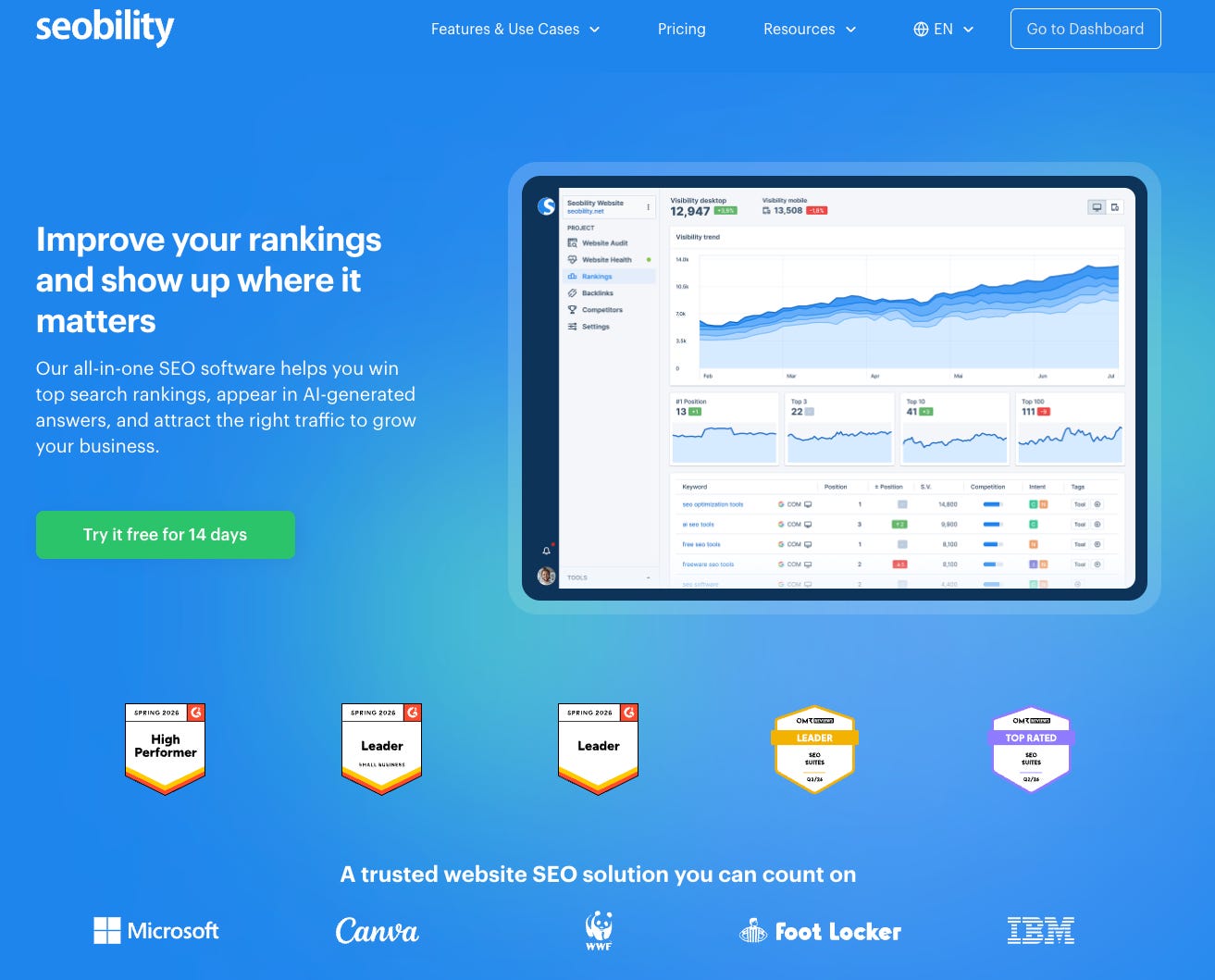
There was never a viral moment. The German SEO community was initially slow to warm to new tools.
“It really was simply hard-won through our own SEO work.”
One Per Cent Pay, and That Is the Plan
Around 100,000 registrations come in every year, and roughly one per cent convert to a paid plan. What sounds like weak conversion is in fact how the model works. The free checks still bring in the most traffic and the most sign-ups. Reach was never bought.
The entry point for almost everyone is a check of a single URL. The real value sits one layer deeper, in the website audit that crawls the entire site and surfaces problems invisible at page level. Duplicate content only becomes apparent when everything is laid out side by side.
The free tier was almost too generous for a long time. Limits had to be lowered repeatedly because power users were running the website audit professionally without ever upgrading. Support volume stays manageable regardless, because the analyses largely speak for themselves.
There is also a geographic imbalance: English-language sign-ups now outnumber German ones, yet paying customers remain concentrated in the DACH region.
Deliberately Doing Less Than the Giants
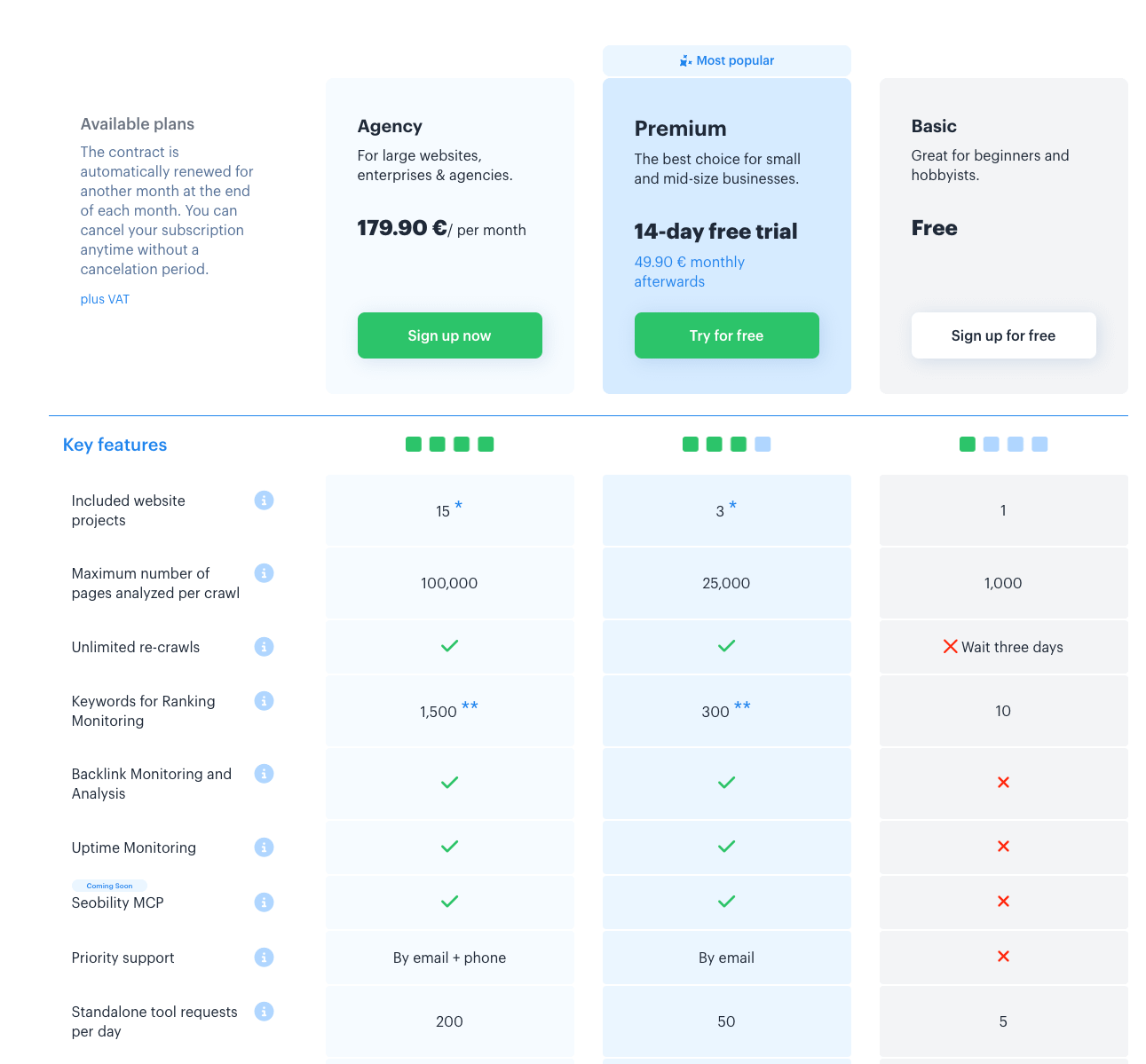
Ahrefs and Semrush start in the triple digits per month. Seobility starts at 49.90 euros. Matthias does not dispute that the large suites do more. He considers it the wrong benchmark, because most users are not full-time SEOs and get lost in that much functionality.
“More features inevitably means a worse user experience at the end of the day. That is unavoidable.”
The strategy is a deliberate 80/20 offering: the functions that deliver the most value, and nothing beyond that. The cost is named honestly – customers who develop into experts eventually outgrow the product and leave. The current construction site is the agency plan, which is defined too heavily by higher limits rather than by capabilities of its own.
What AI Has Actually Changed
The obvious expectation was that everyone would now want to know how visible they are in AI answers. In practice, the MCP server is in far higher demand than AI visibility tracking. Customers want their SEO data inside their own agents, not in yet another dashboard.
“For a very, very long time we were surprised by how little demand there was for it.”
Matthias does not see AI making search engine optimisation obsolete. Most web traffic still comes through classic search, and the biggest lever for showing up in AI answers is, of all things, sound classic optimisation.
Bootstrapping on Steroids
Matthias has his own term for the setup inside saas.group. Accounting, HR, recruiting and analytics run centrally as shared resources that a company of this size could never afford alone. The group deliberately buys profitably grown businesses rather than turnaround cases.
“But they do not steer the company. I do.”
He held no equity when the sale happened. He wanted to prove himself first. The company then performed very well, he became CEO, and the window had closed.
“Modesty may be a good quality, but it is not a good negotiating strategy.”
What I Learned in the Interview
A free tier is product work, not a marketing channel. The SEO check existed before the company and still carries the funnel today. That only works because the free tool is genuinely useful in its own right, rather than built as bait.
Fewer features are a position, not a weakness. The idea that choice itself can slow users down is uncomfortable when your own roadmap is full.
Operator is not a diluted founder role. Matthias does not work a 40-hour week and describes his responsibility as entrepreneurial, even though he neither founded the company nor holds shares in it.
Learnings for Founders
Earn reach before you buy it. A free tool that delivers real value can work more cheaply and more durably than any ads budget.
Review your free tier regularly. If power users can work professionally inside it, you are giving your product away rather than selling it.
Differentiate plans by capability, not by limits. Where only the numbers go up, nobody grows into the more expensive plan.
Stay close to support. Matthias still answers emails as CEO and calls it the best source for what customers are missing.
Do not trust your assumptions about the market. Demand did not go to the obvious feature, but to access to the data.
Negotiate for yourself while the window is open. It rarely opens a second time.
The full interview on YouTube (German):
Happy Bootstrapping is a German podcast where I interview bootstrapped founders, indie hackers, and solopreneurs about their startup journeys.
Over the years, I’ve connected with many successful entrepreneurs who have built e-commerce shops, SaaS platforms, mobile apps, content businesses, or hybrid models.
Furthermore I am a bootstrapper myself and growing my DevOps-as-a-Service and Web Operations Company “We Manage”.
I discovered your podcast last year, and I love it! What I like most is that you cover all kinds of stories, from people who have built very successful businesses to those who are just getting started.
I also really like how you guide the conversation with your questions in a way that gets people to share useful and actionable advice.
Thanks for creating such a great podcast!