

Pascal Lukas sells fruit and vegetables that would never reach a supermarket shelf. Too small, too large, too bent, a blemish on the skin. With Rübenretter he buys this produce directly from the grower and ships it by subscription. It now brings in three to three and a half million euros a year, at ten to fifteen tonnes a week. Founded in 2017, with no loan and no investor.
This is a summary of Episode 186 of the “Happy Bootstrapping” Podcast (German).
The produce is harvested specifically for them
The most common misconception about Rübenretter is that it collects leftovers. The produce comes neither from retailers nor from a warehouse, but from the field, harvested specifically for Rübenretter. Without that order it would be left standing and destroyed, because the expensive part is not the vegetable itself but the harvesting, washing, marketing and delivering.
“We’re in touch with the farmer and buy up whatever’s imperfect out in the field.”
Rübenretter therefore pays no bargain price, but roughly what the grower would receive for perfect produce. Not every customer grasps this straight away, which keeps the product permanently in need of explanation. How much of a harvest turns out imperfect depends on the weather; Pascal estimates thirty to forty per cent.
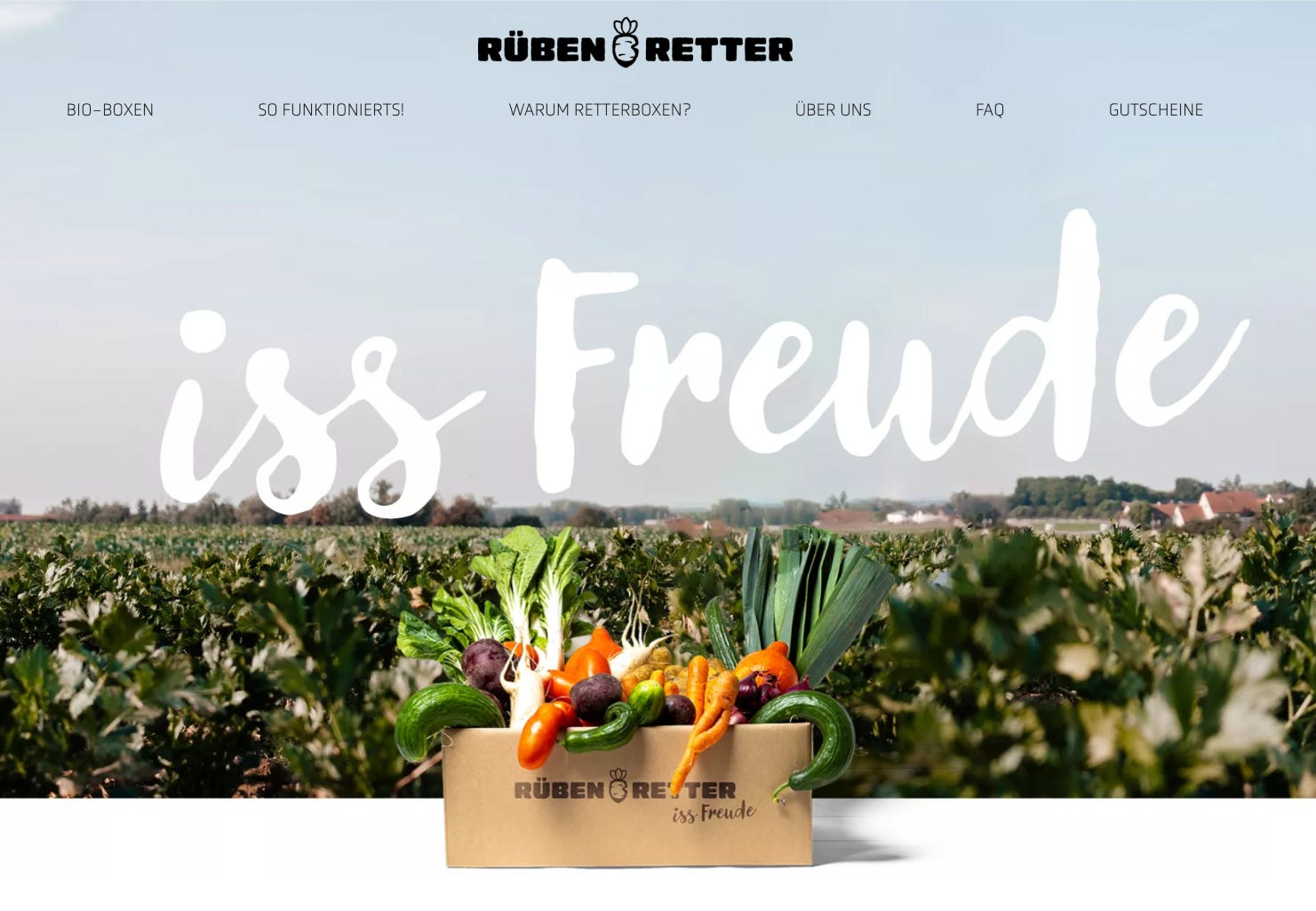
Six boxes in a garage
Pascal trained as a retail salesman in his parents’ fruit and vegetable business. He originally wanted to build an online shop for perfect produce, but the cost of printed boxes stopped him. Then the family sold bent cucumbers at the market stall one week because no straight ones were available, and customers loved them.
“And then we basically just started, completely naively.”
It began in May 2017 with around 2,000 euros for cardboard and six boxes a week, packed in the garage behind the market stall. The first customers came through the press, then through influencers, who back then still posted in exchange for a single box. One brought sixty orders in a day, when the business packed a hundred boxes a week. By the end of 2019 it was no longer a side project.
The Covid rollercoaster
Then came lockdown, and delivering groceries turned into a mass market overnight. At its peak Rübenretter shipped 6,000 boxes a week with forty people on the packing team. The fall was just as fast, because subscriptions are the first thing people cancel. In the worst month it was 1,300 boxes, with fixed costs unchanged. Only this year has the curve turned up again.
The subscription is not an optimisation, it is a precondition
Plenty of customers ask for one-off orders. Rübenretter cannot offer them. Order volumes go to the grower two weeks in advance so he can plan what to harvest and for whom. Without that lead time the model does not work, and it is precisely why almost nothing is thrown away. Margins stay tight anyway, because the customer always has the supermarket price in mind.
“The vegetable itself isn’t the decisive part, it’s everything around it that’s madness.”
Cardboard, marketing and the last mile drive the price. Pascal did the maths on shipping: DHL Express would have raised next-day delivery from 89 to 95 per cent, at seven euros more per parcel. Those six percentage points were not worth it.
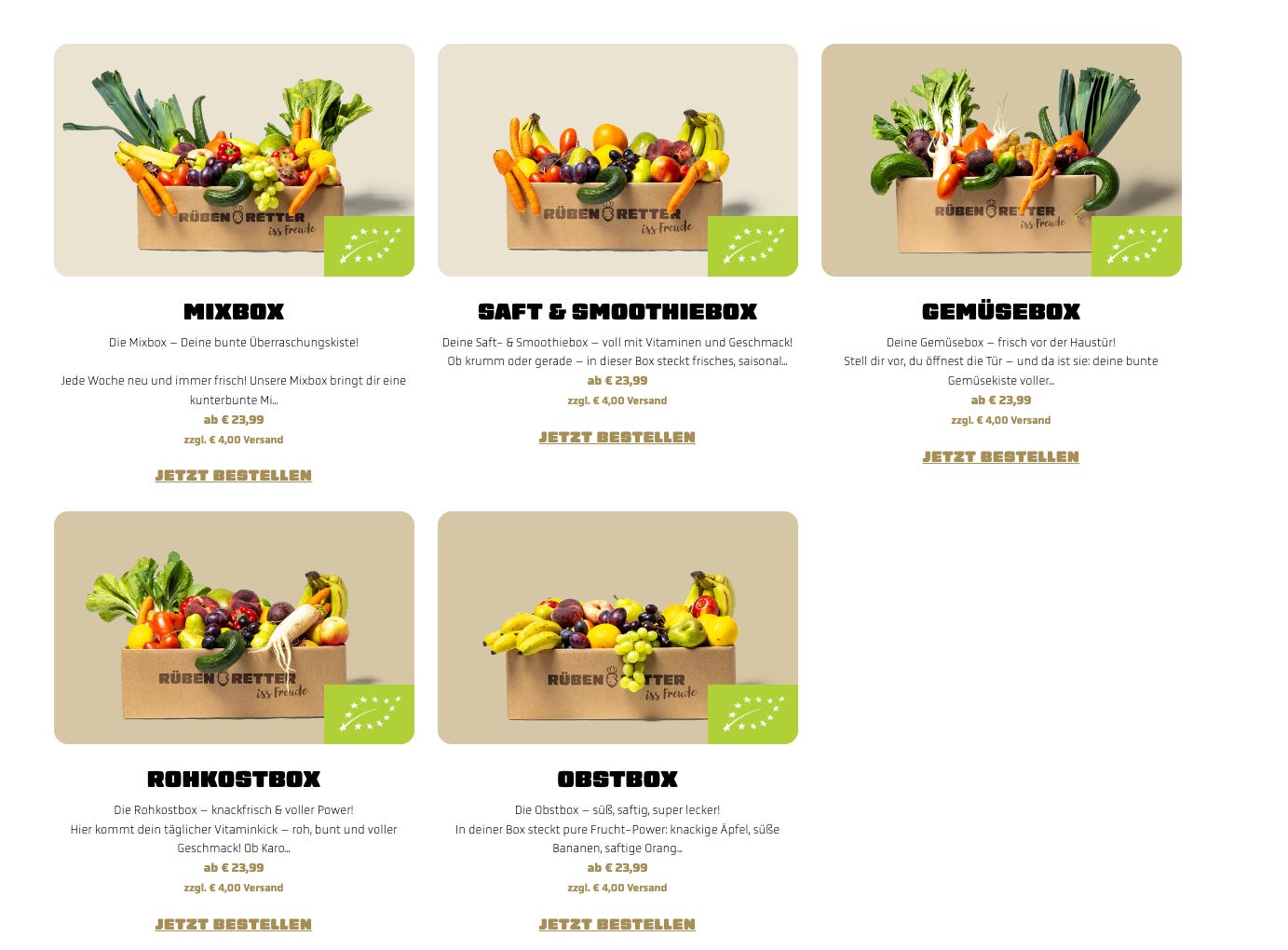
Bringing logistics back in-house
At the end of 2024, Rübenretter handed packing over to a large organic wholesaler. In January it comes back. The organic certification brought more imported produce into the range while customers were asking for regional sourcing. Many small farms nearby effectively grow organically but cannot afford the certificate. From January the boxes will be packed without certification, but more regionally.
“The really, really big reason is that we simply miss the product and that’s why we’re bringing it back, because we feel our heart and soul is gone.”
Alongside it runs the second brand, fruvi: perfect produce, boxes customers assemble themselves, one-off orders. Exactly what Rübenretter structurally cannot offer.
Two years of migration, then building it himself
The biggest source of frustration was technical. Two agencies spent two years trying to build a subscription plugin for Shopware 6, because 8,000 subscribers paid by direct debit and Shopify could not handle it. Both failed; with one, contact eventually ran through a solicitor. An in-house build followed, and now, in September, the move to Shopify is happening after all. Pascal builds the warehouse software himself these days using Claude Code.
“And now I can build in every little thing we might need, myself, and it makes the work so much easier.”
What I took away from the interview
What stayed with me most is how much the model depends on the consumer rather than retail. Supermarkets sort for perfection because we shop for perfection.
“They’ll look at the pepper three times to make sure it hasn’t got a mark on it, and then take the perfect one.”
That is why Pascal does not believe wonky produce will ever work in a supermarket, and why Rübenretter exists at all. I also found it striking how matter-of-factly he dismisses the investor question: no principle, no ideology, just no need.
The Full interview on YouTube (german)
Lessons for founders
Press is a channel, not a business model. Rübenretter grew on newspaper and television coverage. Pascal feels the absence of a recent feature in customer acquisition.
Some constraints are the foundation. The subscription is not a growth trick but the condition under which almost nothing gets thrown away.
Weigh service levels against cost. Six percentage points of delivery were not worth seven euros a parcel.
A failed migration costs more than the project. Two years, two agencies, a solicitor, and a legacy system limping along throughout.
Direct mail isn’t dead, just unglamorous. Postcards to existing customers and their neighbours beat the elaborate mailer that goes in the bin.
Happy Bootstrapping is a German podcast where I interview bootstrapped founders, indie hackers, and solopreneurs about their startup journeys.
Over the years, I’ve connected with many successful entrepreneurs who have built e-commerce shops, SaaS platforms, mobile apps, content businesses, or hybrid models.
Furthermore I am a bootstrapper myself and growing my DevOps-as-a-Service and Web Operations Company “We Manage”.