

In episode 182 of Happy Bootstrapping I spoke with Raphaela Franke, the founder of RaphRoxs. She builds mountain bike apparel exclusively for women – as a one-woman show, fully bootstrapped, produced in Italy and Portugal. We recorded the conversation while she was sitting in a bike park between two bike festivals.
This is a summary of Episode 182 of the “Happy Bootstrapping” Podcast (German).
From Electronics Apprentice to the Textile Industry
Raphaela’s path starts far away from bike pants. She trained as an electronics technician and was close to studying electrical engineering when her company filed for insolvency during her second year of training. In that idle stretch as an apprentice, she realized how strongly the creative side pulled at her.
She added a second apprenticeship, as a fashion designer and tailor, to combine her hobbies of design and sport. Her first job took her straight to Engelbert Strauss, then to Schöffel, where she looked after bike wear and team wear for ski schools and the ÖSV. The expertise in functional apparel that later feeds RaphRoxs comes entirely from those years as an employee.
Why a Brand Only for Women
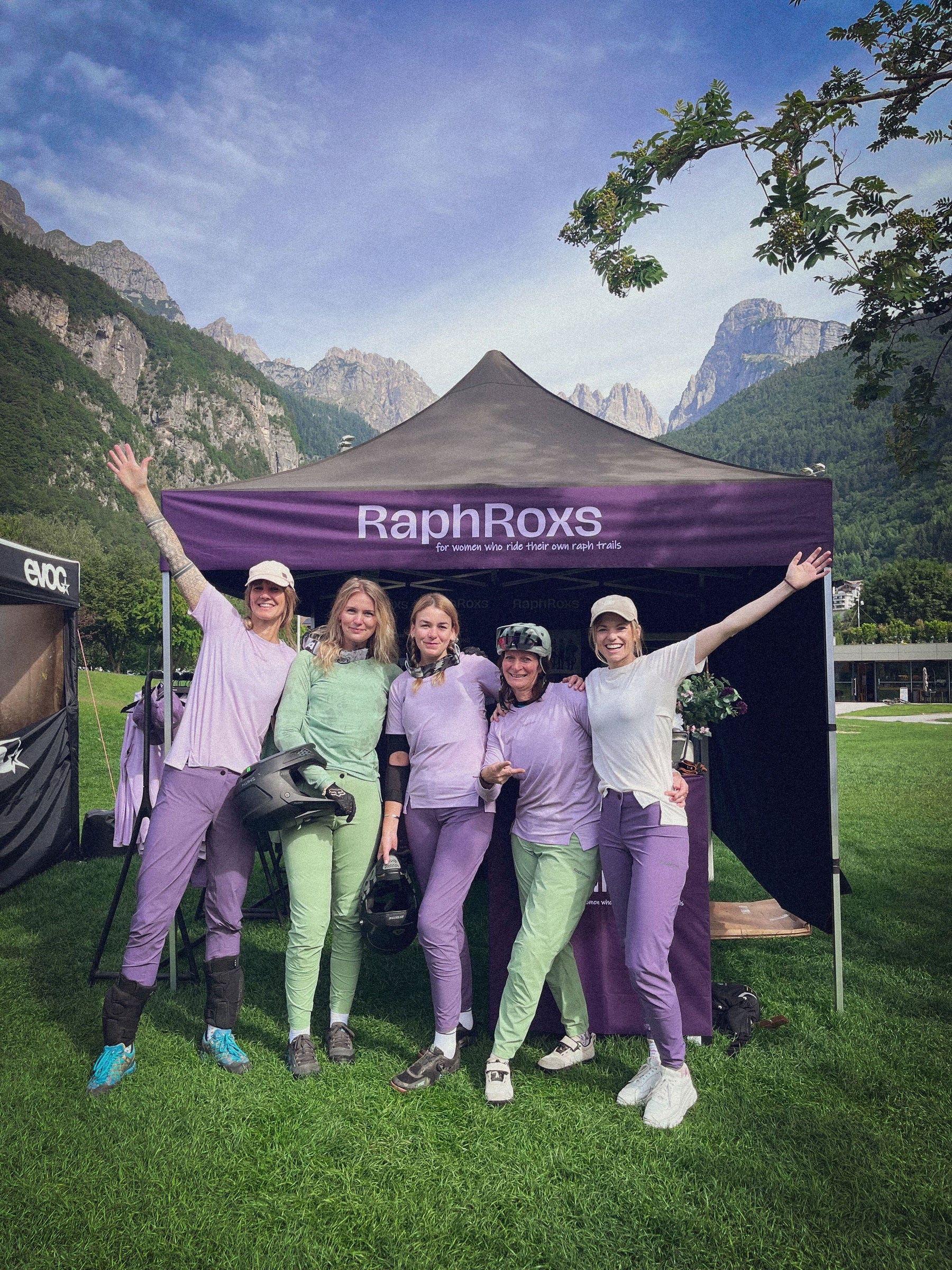
The idea grew out of her private circle. Through a friend, Raphaela got deep into the women’s mountain bike community and started talking there about her prototypes. The response from the other girls showed her the potential. For larger companies, focusing this tightly on one target group is often a matter of time and cost.
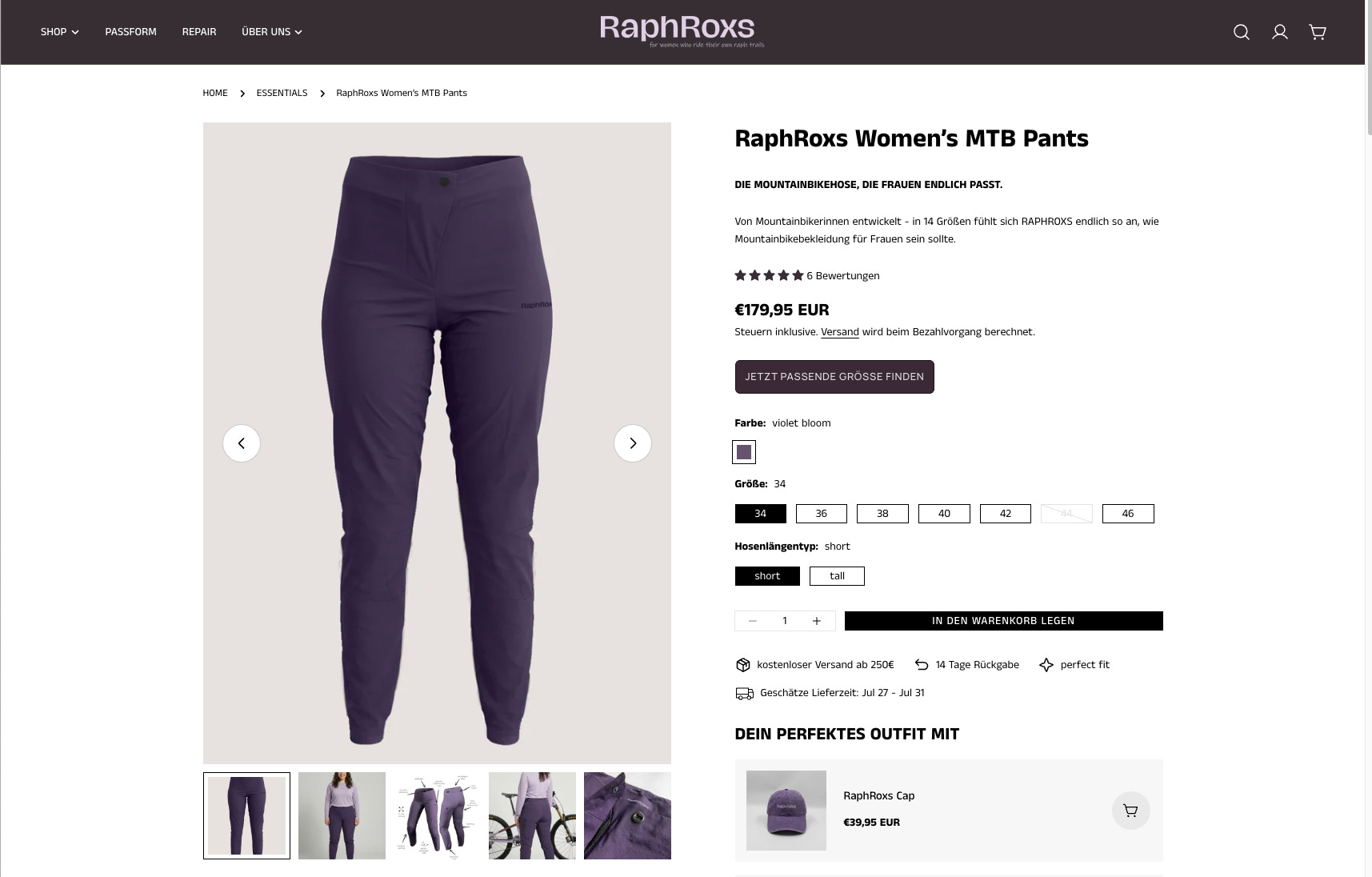
That is exactly where RaphRoxs comes in. The main factor is fit, because a woman’s body has to be cut differently and many brands don’t go into that detail. For the pants she offers seven sizes from 34 to 46, each in two lengths – that makes 14 variants. Otherwise tall women often have to shop in the men’s section, where the pant simply doesn’t sit right everywhere.
All In on One Card
Unlike many guests here who start on the side and only later switch to full-time, Raphaela quit and went all in right away.
“For me it was: I do it all the way or not at all.”
Her last day at work was April 30, 2025, and she launched exactly one year later. Still, she didn’t jump in blind: she had saved consistently since her first apprenticeship, brought in a business consultant who took away her fear, and got a financial cushion from her parents. What stands out is how quietly she took the step. From an earlier attempt she had learned that constant reminders of “but you have a secure job” cost energy – so this time she told almost no one.
Sourcing Was the Bottleneck
The most demanding part of the year wasn’t the design – that’s her craft – it was finding manufacturers.
“I stood in my own way a bit, because I was always afraid that the moment I wrote to them, I’d get an instant rejection.”
It was about rejections from factories she hadn’t even contacted yet. The cutting work, which she masters herself, she deliberately handed to an external expert to save time. Production is intentionally in Europe – the pants in Italy, the tops in Portugal. Making technical textiles in small quantities and good quality there was the real hurdle.
The whole thing is capital-intensive. The pant retails at 179.95 euros and sits in the higher price segment, which Raphaela justifies with Made in Europe, small batch sizes and the community approach. Everything is stored and shipped from a 16-square-meter room in her home.
The Community Is the Marketing Channel
Her target group is extremely narrow: female mountain bikers. That is exactly where Raphaela sees the advantage. The first orders came at launch through her community, without her having time for a polished strategy.
“There’s none of that elbowing, actually none at all, but rather this intense support and helpfulness.”
One girl gets into the pant, likes it, shares it – the next one comes along. At events Raphaela stands at the booth herself, with a QR code for Instagram next to her. She finds this more human than running Meta ads, but admits it’s barely measurable – she can only read the impact from follower counts, sales and how busy the booth is. Right now she sells in the triple digits and is still fully in build-up mode.
What I Learned From the Interview
The launch isn’t the start of the work but the end of a long, invisible phase. A year of product development is actually fast in the textile world – from the outside people only see the finished shop and assume immediate revenue.
A narrow target group can be a sales advantage: because the women’s bike community carries itself, word of mouth becomes a growth engine without an ad budget. And the biggest bottleneck wasn’t a lack of skill, but the fear of a no.
The full episode is now also on YouTube (German only):
Learnings for Founders
“All the way or not at all” can be the clearer path – but only with a safety net. Raphaela jumped in full-time while having savings, a consultant and family backing behind her.
Outward visibility says nothing about maturity. Expect a year of groundwork to look like standstill from the outside.
A narrow niche is a feature. The stronger the cohesion of your target group, the better referral marketing carries – especially without an ad budget.
Delegate what slows you down, even if you can do it yourself. Raphaela handed off the cutting work to move faster.
Your own fear is often the biggest time sink. A rejection from a manufacturer is not failure – the sooner you internalize that, the faster you move.
Never grow faster than you grow as a person and entrepreneur. Raphaela deliberately wants to bootstrap step by step.
Happy Bootstrapping is a German podcast where I interview bootstrapped founders, indie hackers, and solopreneurs about their startup journeys.
Over the years, I’ve connected with many successful entrepreneurs who have built e-commerce shops, SaaS platforms, mobile apps, content businesses, or hybrid models.
Furthermore I am a bootstrapper myself and growing my DevOps-as-a-Sercice and Web Operations Company “We Manage”.