

Olga Heuser used to work as an adviser in the German Bundestag, while her husband Stefan was a management consultant. Neither of them came from the hotel industry. Even so, in 2019 they founded DialogShift, an AI for communication between hotels and their guests. Today around 1,500 customers use the software, the team has about 20 people, and the two of them have never taken money from investors.
The idea came on a family holiday
The couple were staying with their children at a large resort in the south of France. Kids’ club, sports programme, several restaurants, evening entertainment. There was no app, just a stack of flyers in the bungalow. Olga simply wanted to ask on WhatsApp when the next Pilates class was and get an answer straight away.
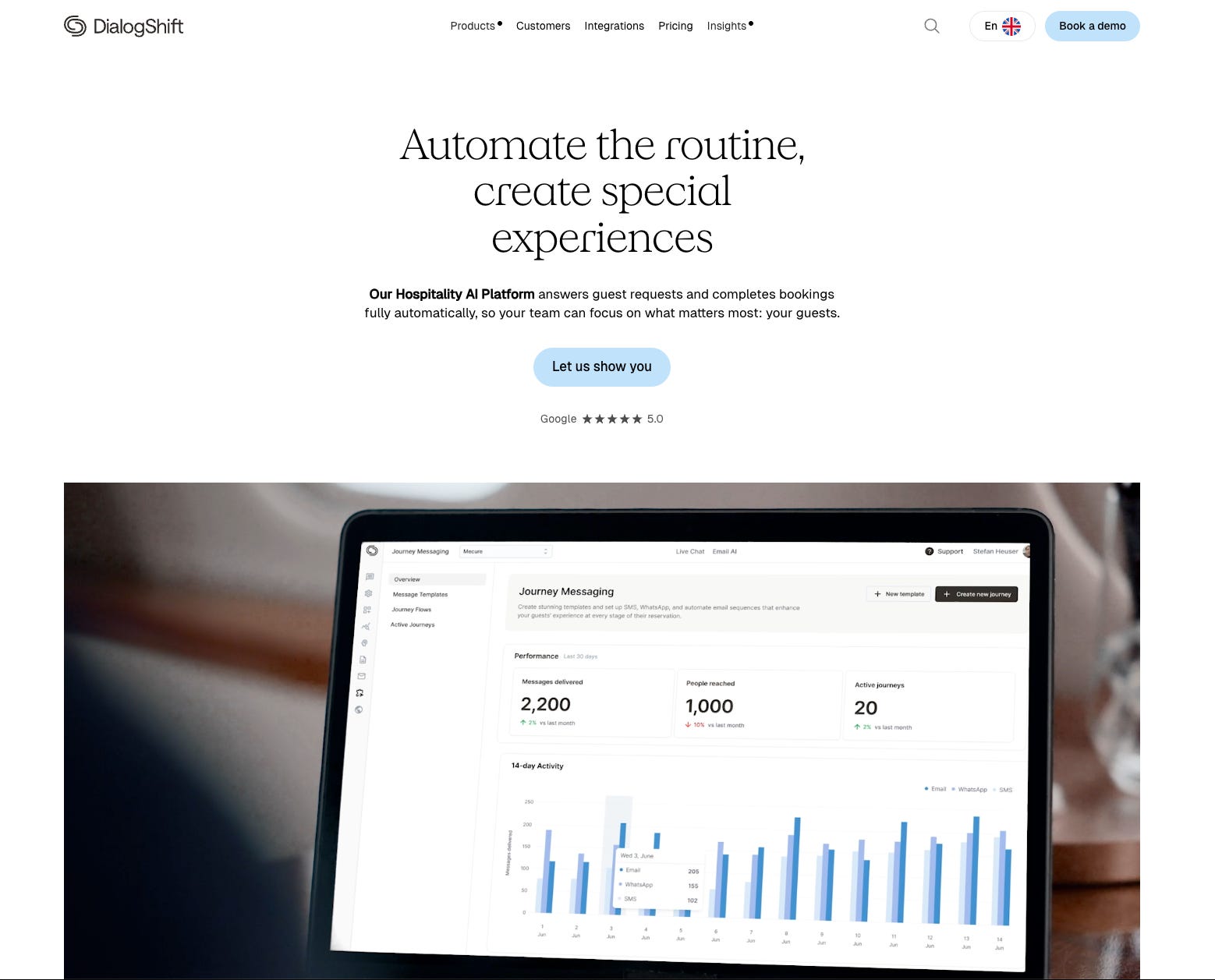
That turned into a chatbot for hotels. In the early days Olga trained the German language models herself, writing question variants by hand: how many different ways can someone ask when breakfast is served? Today DialogShift is a central AI for phone, email, chat and journey messaging, meaning proactive messages such as a welcome note after check-in. On the phone, an AI agent guides guests through a booking and enters it straight into the hotel’s system. The largest customer is the budget hotel chain Motel One, with more than 100 hotels.
COVID: almost no revenue
At the start of 2020 the product was running with the first 10 to 20 customers, and the year was supposed to be the real launch. Then lockdown hit. Hotels stopped buying new software and the existing revenue froze. The couple kept afloat by building chatbots for hospitals, Stefan carried on working alongside until mid-2021, and at home there were two small children.
Olga admits today that she does not know whether she would hold on that long again in the same situation. What helped was that there were two of them:
“If I had been a solo founder, I wouldn’t have lasted through that hard phase for so long.”
When hotels reopened, contactless communication was suddenly in demand. Healthcare could have been a second market, but running two go-to-market strategies is hardly possible when you are bootstrapped. They chose hospitality. From 2022 DialogShift grew quickly, and today its recurring revenue is in the mid seven figures.
Pricing per room and customers from the stage
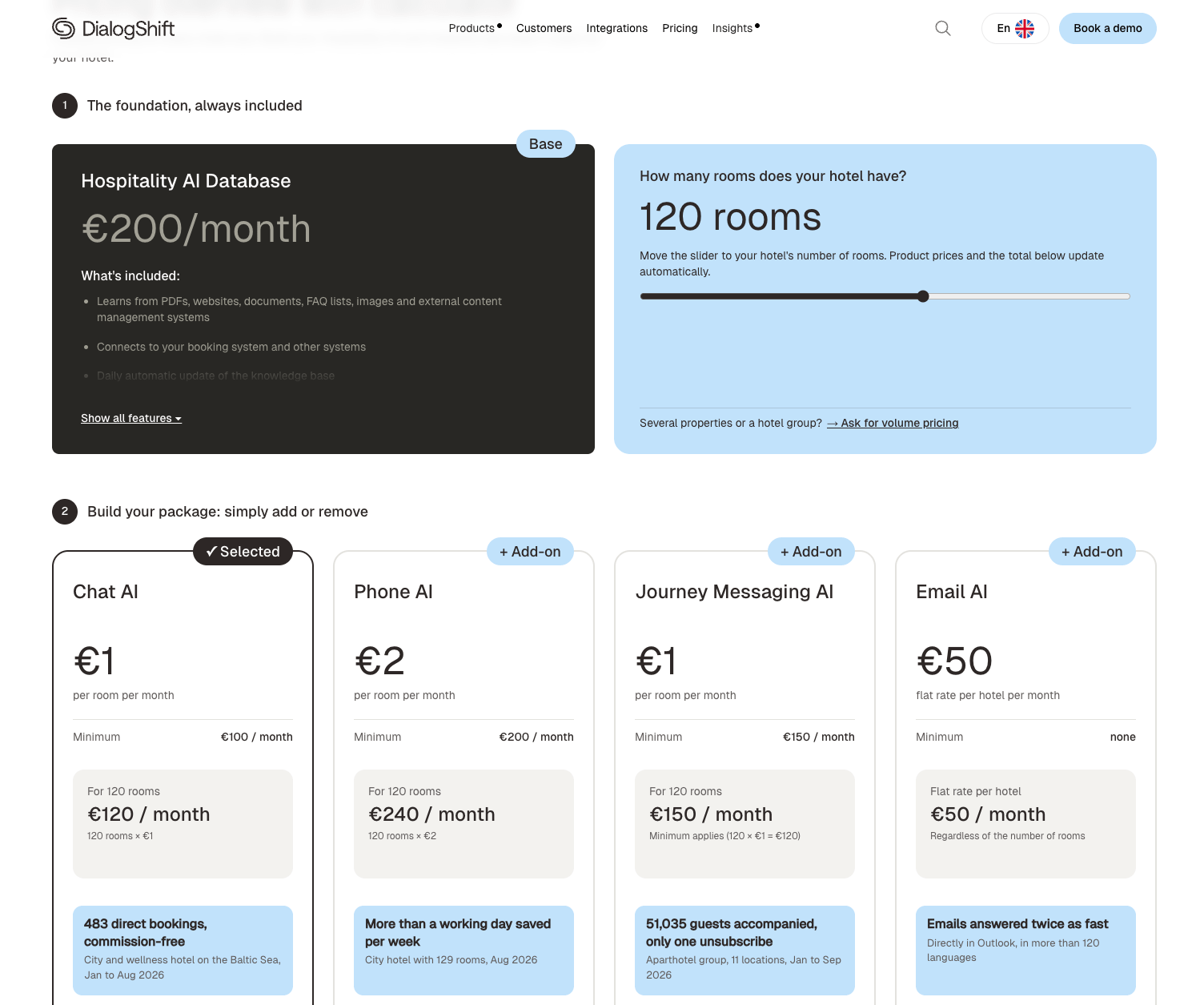
Billing is per room, as is common in the industry. The platform costs 200 euros a month, plus individual modules. The phone AI was initially priced per minute. They quickly switched to a flat fee, because hotels need to budget their costs in advance.
The first ten customers came from two pitches at industry events, one at the German Hotel Congress and one in Zurich. After that, DialogShift grew mainly through inbound: talks, trade media and, in 2023 alone, 13 AI workshops for Austrian hoteliers. Apart from ITB in Berlin, Olga is not a fan of trade fairs. A public AI workshop with an hour and a half of straight lecturing, on the other hand, paid off:
“There were 600 people in it. I reach so many more people that way than in four days at a trade fair.”
The workshop was neutral, and Olga presented competitors as well. DialogShift now produces its own vidcast format together with a partner. Olga sold and onboarded the first 300 customers herself. Only in the last year or so has the company been building a sales team, now five people including a head of sales.
Why no investors
Olga regularly gets enquiries from VCs. She answers every one of them politely with a form. Still, the decision against outside capital was made deliberately and early:
“We could never have run the VC model, that grow big or go home approach.”
With two small children, that model was not an option. Then there is the freedom: DialogShift has even let customers go when they were not a good fit. And when the underlying technology changes, the two of them decide without having to consult a board.
Asked what stops a hotel from simply rebuilding DialogShift with Claude, Olga gives several reasons: phone systems as hardware, security around guest data, industry knowledge and ongoing development. The first draft might come together quickly, she says, but the remaining 30 per cent takes most of the time.
For women founders in particular, Olga sees bootstrapping as the more direct route. Women find it harder to raise capital, and without investors nobody has to sign off on the idea first:
“The validation then comes from the customers.”
What I learned from the interview
What impressed me was that Olga and Stefan did not know the hotel industry from the inside. They had the problem themselves, as guests, and learned the industry from there. Surviving COVID with hospitals and then still committing to a single market struck me as very consistent.
The comparison between trade fairs and webinars also stuck with me. 20,000 euros and two people for a few days on a stand, against a neutral workshop with 600 participants. And on the subject of AI copies, Olga explained well why the last 30 per cent of a piece of software makes the difference.
Full video on YouTube (German)
Learnings for founders
Build your pricing around how customers budget: per-minute pricing put hotels off, a flat fee per room did not.
The first customers came from two pitches at industry events.
Neutral content brings more reach than promotional events.
Doing sales yourself for a long time is hard, but it keeps the company independent.
Letting go of customers who are not a good fit is part of the freedom.
Happy Bootstrapping is a German podcast where I interview bootstrapped founders, indie hackers, and solopreneurs about their startup journeys.
Over the years, I’ve connected with many successful entrepreneurs who have built e-commerce shops, SaaS platforms, mobile apps, content businesses, or hybrid models.
Furthermore I am a bootstrapper myself and growing my DevOps-as-a-Service and Web Operations Company “We Manage”.