

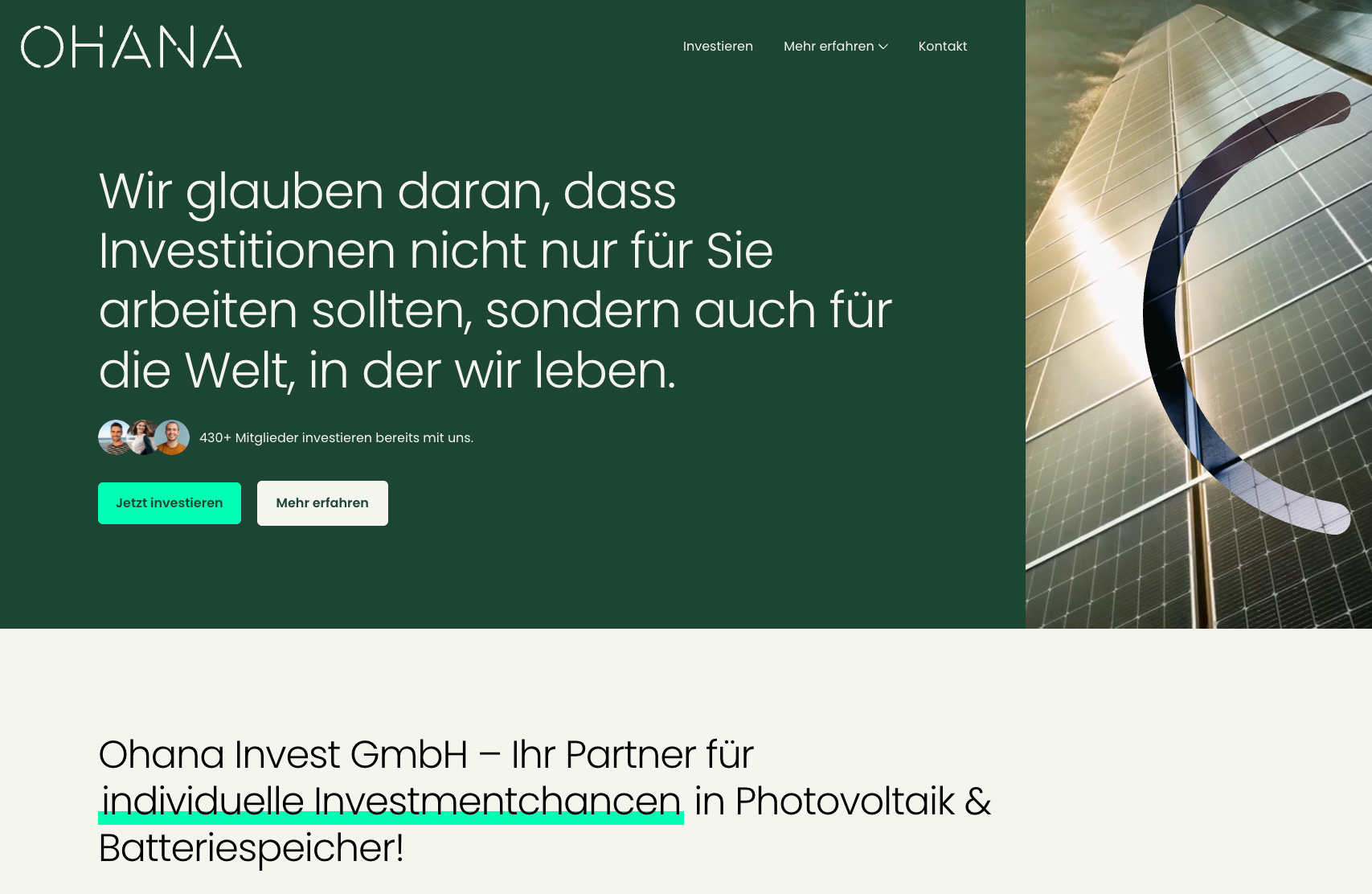
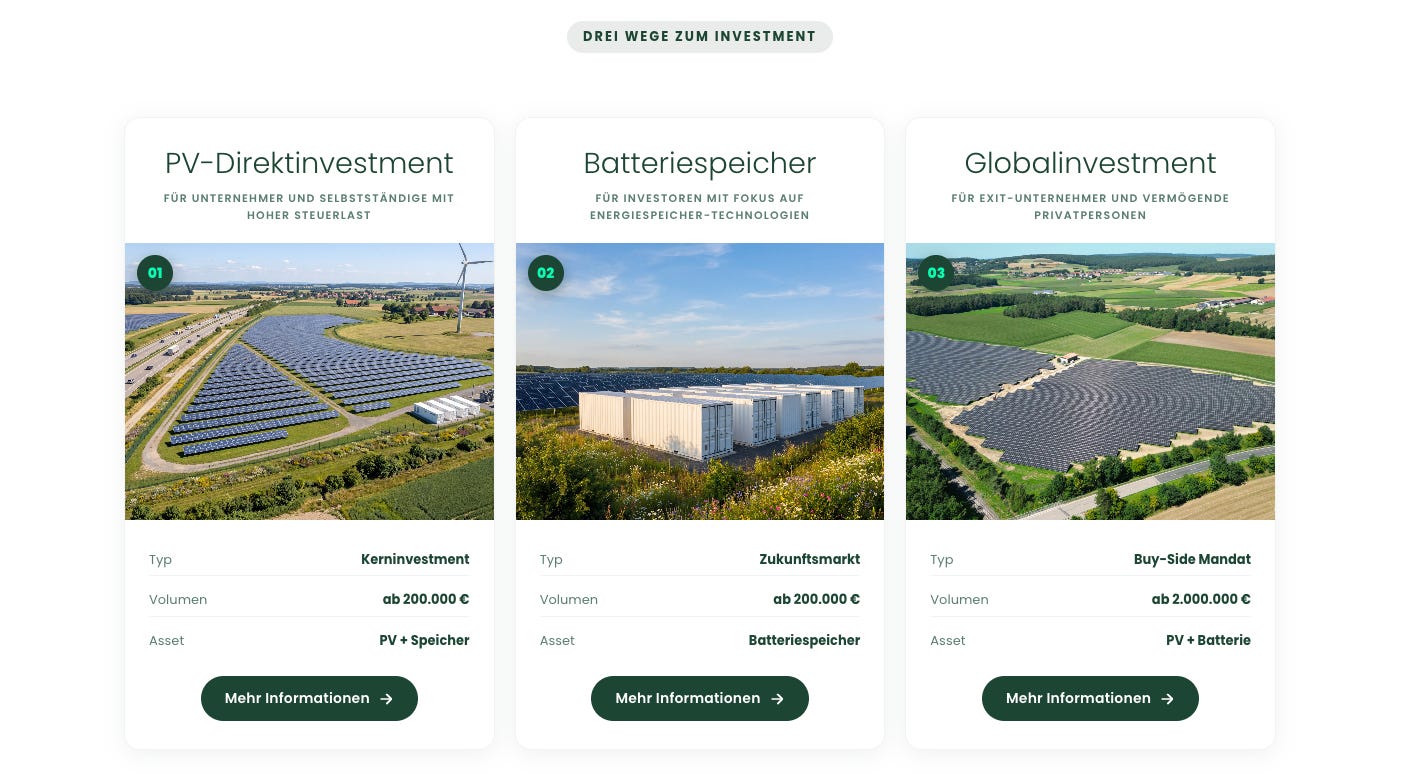
homas Haberl is a co-founder of OHANA Invest in Regensburg. OHANA splits large ground-mounted solar parks with battery storage into plots that private individuals can buy, much like a flat in a large residential complex. In 2025 the team brokered €60 to 65 million in investments, and for 2026 Thomas expects up to €120 million. That is brokered volume, not revenue.
This is a summary of Episode 194 of the “Happy Bootstrapping” Podcast (German).
From DRACOON to a family holding
Before OHANA, Thomas grew DRACOON, an enterprise file cloud, from zero to 100 employees. Thanks to its focus on data protection, even Germany’s central bank became a customer. The sale closed shortly before Christmas 2023.
His plan afterwards was a private investment holding, hence the name: Ohana is Hawaiian for family and close friends.
“In a family, you don’t cheat anyone, so to speak.”
Then Roland, from whom Thomas had bought several listed properties over the years, came to him with the idea of offering PV parks together. They went to the notary in September 2024, and the website went live that November.
“We wanted to start smaller and take it easy. That didn’t last long.”
No investors this time
DRACOON had venture capital on board. With its own data centre and public-sector tenders that could take up to two years, Thomas still thinks that was the right call. He still calls it a pact with the devil:
“I get money for speed.”
When cash flow gets tight, the investor’s position for the next round improves.
“The investor’s job is to get as many shares as possible for as little money as possible.”
Somewhere between 20 and 50 employees, more managing directors and a management layer came in, and Thomas gradually lost his say. At OHANA he makes the decisions again, including who to hire. Many of the salespeople from his old company followed him into an entirely different industry. Advising a public-sector client for months turned out to be good training for advising investors, where trust matters just as much.
How OHANA makes money
OHANA sees itself as a broker. The listed fee is 3 to 4 per cent, but according to Thomas hardly anyone pays it in full. On top of that come marketing subsidies and closing bonuses from the project developers. With its own volume, the team now goes to developers directly, orders several parks of 10 to 15 megawatts for the coming quarter and negotiates prices and contracts on behalf of its investors.
OHANA stays involved after the sale. If there are problems with operations or billing, the team speaks to the developer for all investors in a park. Thomas himself has invested a seven-figure sum in the parks.
How a plot pays off
A typical plot costs around €200,000. Under the German investment deduction (Investitionsabzugsbetrag, IAB), up to half of that can be claimed retroactively for tax purposes. Thomas works through an example with an annual income of €120,000: instead of deducting €100,000 in one year, you split it into €50,000 across two tax returns and stay in the top bracket. Around €44,000 comes back and serves as equity for the bank, which typically finances 80 per cent over 20 years. Thomas still recommends bringing in a tax adviser.
What matters is the revenue per kilowatt hour, and that depends on the size of the battery. With a 30 per cent battery share, Thomas considers 8 to 9 cents realistic, with 50 per cent 9 to 10 cents. In Germany, modules lose around 0.15 per cent of their output each year, batteries considerably more. His rule of thumb:
“After all costs, including interest and repayment, there should be a positive contribution.”
What investors should look out for
Before selling a park, OHANA checks that it is ready to build: grid connection and planning permission confirmed, transformer stations ordered. These currently have lead times of 30 to 40 weeks, so a developer who waits for investors’ money before ordering them is a warning sign. Payments follow construction progress, with a monthly construction report. In 2025, all eight projects OHANA helped sell were connected to the grid on time. In 2026, delays of a few weeks are more common.
Thomas sees the biggest risk in the project developer. He works with companies that have been around for 15 or 20 years. He advises caution with online portals and lead sellers, and suggests checking the legal notice, company records and managing director. Investors own their modules, inverters and batteries outright and can switch operators if something goes wrong.
Next up: charging points at supermarkets or gyms, and standalone battery projects.
“The nice thing for us is that we’re under no pressure to add nonsense to the range.”
Full Episode on YouTube (German)
What I learned in the interview
Investor money is a trade. Thomas doesn’t regret DRACOON. He is simply very clear about what you give up: shares, decisions and, at some point, the feeling that it is still your own baby.
Size shifts the negotiating power. With its own volume, OHANA no longer just sells finished offers but orders parks on its own terms.
An investor who buys once comes back. That is why the business doesn’t end with the sale for OHANA. Operations, billing and a masterclass for all investors in Munich are part of it.
Learnings for founders
Before taking outside capital, decide how much control you are willing to give up in later rounds.
A good team will follow you into a new industry if you have treated them fairly.
For products built on trust, transparency counts for more than a lead form.
Bundling volume lets you negotiate better terms for your customers.
Investing in what you sell yourself builds credibility.
Happy Bootstrapping is a German podcast where I interview bootstrapped founders, indie hackers, and solopreneurs about their startup journeys.
Over the years, I’ve connected with many successful entrepreneurs who have built e-commerce shops, SaaS platforms, mobile apps, content businesses, or hybrid models.
Furthermore I am a bootstrapper myself and growing my DevOps-as-a-Service and Web Operations Company “We Manage”.