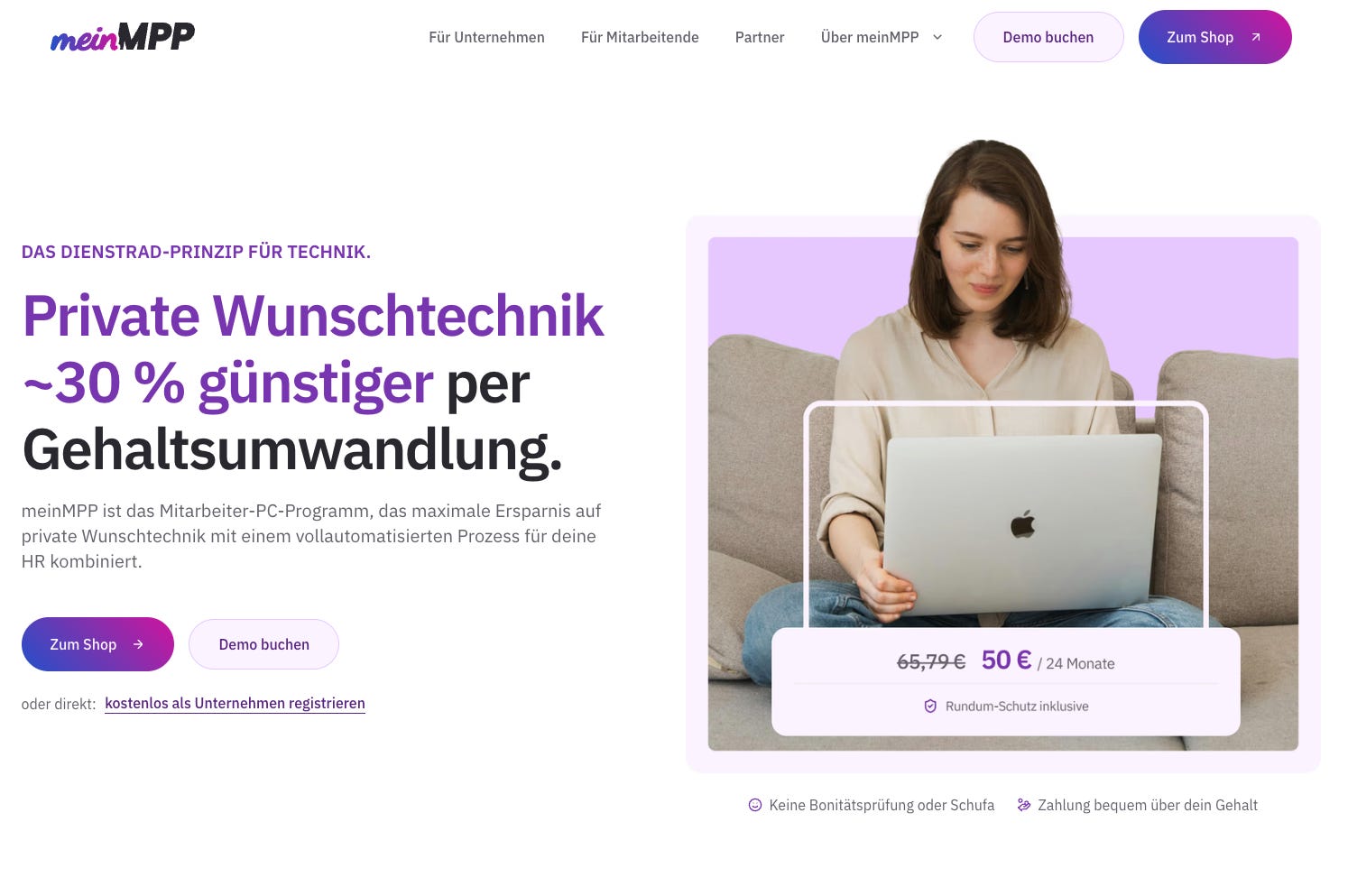
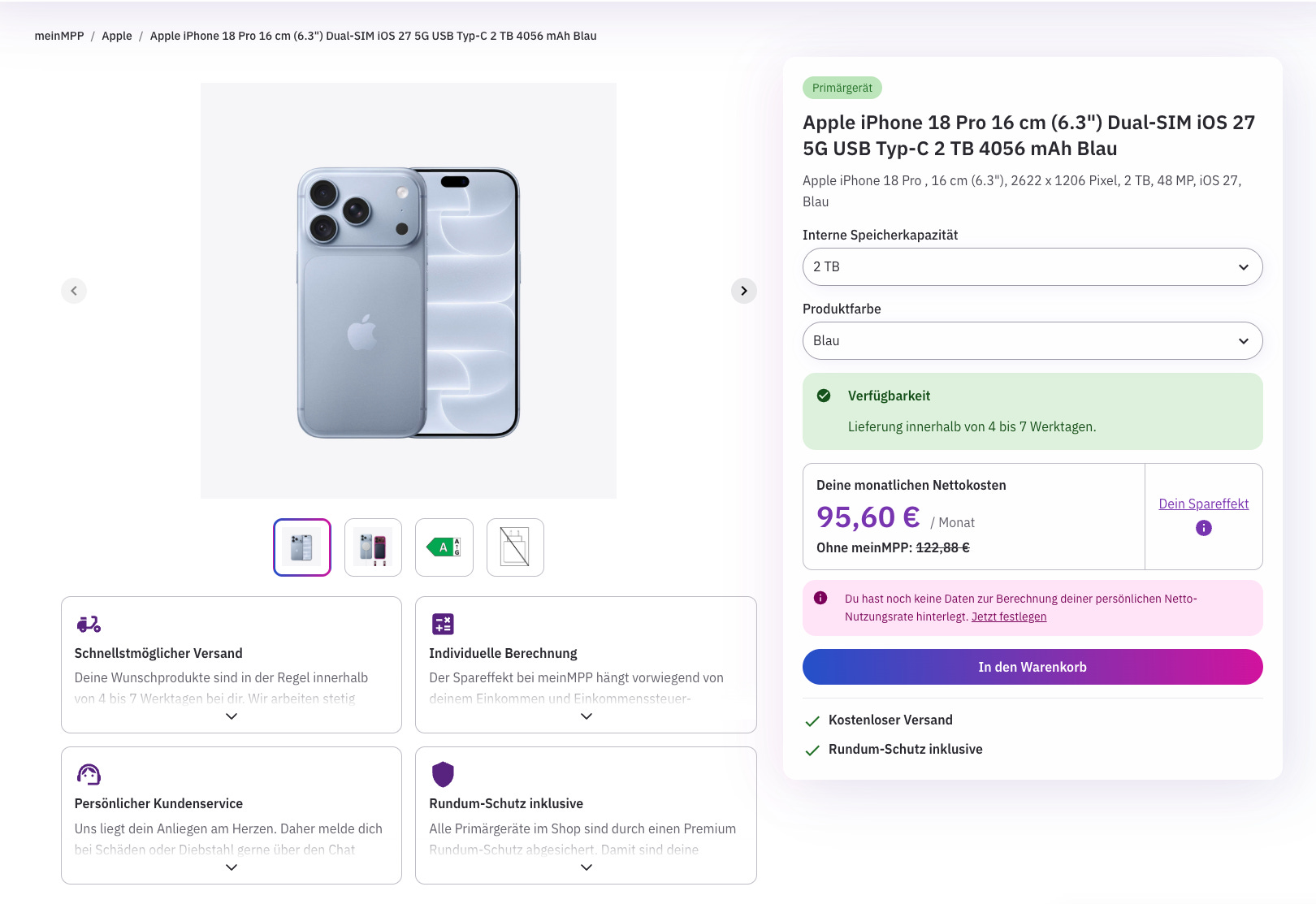
Dominik Albers is the managing director of meinMPP and its only employee. The employee PC programme applies the logic of Germany’s company bike schemes to smartphones, tablets and laptops: staff order tech through their employer and pay for it through salary conversion.
Dominik’s background is in e-commerce. He founded an agency with two colleagues, and in 2018 a client came along who ran a leasing company and wanted to build an employee PC programme. The brand name came from him too. Because employee benefits interested almost nobody before the pandemic, he gave up, and the agency carried it on.
It soon became clear that running a product does not fit an agency’s business model, and Dominik’s fellow shareholders wanted to shut the project down. He bought the platform out, found two new shareholders – one from leasing, one from service – and launched in January 2022. The inherited software had grown organically and became unmaintainable; a complete rebuild with an external partner followed in 2024.
What employees get out of it
The employer introduces the programme, signs a master leasing agreement and sets budgets. Converting 250 euros of gross salary a month buys hardware worth roughly 4,000 to 5,000 euros; depending on income and tax bracket, the saving against buying outright is up to 30 per cent.
One difference from the bike scheme matters to Dominik: with a bike, both income tax and social security contributions are reduced, whereas the employee PC programme only touches income tax. For staff that is an advantage, because pension entitlements stay untouched; employers save nothing on payroll costs. Prices come from the actual purchase price rather than the recommended retail price, so a Black Week discount reaches the employee.
The margin only arrives two years later
The business model demands patience. Apple accounts for 75 to 80 per cent of order volume, and there is little to be gained on purchase – around one per cent on iPhones. The money is made at the other end: after 24 months the contract ends and staff can buy their device at its residual value. Almost 90 per cent do, and roughly 70 per cent order again straight away.
“The principle is simply to push a lot in at the front, so that at the back there’s a warm shower of money.”
Order volume has doubled on average every year so far, and Dominik is planning at least 2.1 to 2.4 million euros for this year, in which the company will turn a profit for the first time.
Why trade fairs do not work and partners do
The first customer was an energy group in Baden-Württemberg, won through a tender against the market leader. After that it got hard: search volume was negligible at launch, and ads competed with the budgets of IT leasing providers.
“I’m not a salesperson, so I’ve had to learn sales over the past four years.”
Cold calling mostly produced rejections, and trade fairs a sobering ratio: around 100 contacts yielded roughly one deal, usually a small company. Dominik therefore stopped attending fairs and built a partner network of benefits platforms, leasing companies and distributors. More than half of all enquiries now come through it, and platforms increasingly approach him.
“We wouldn’t be where we are today without our partner network.”
One person, heavy automation, away from US tech
That all of this runs with a single employee comes down to consistent automation. Employers have little to do: the payroll export is configured once, after which it is enough to approve new staff and remove leavers. One customer with 200 contracts budgets half an hour a month.
The platform is built in-house on Laravel, with Filament for the admin panel. AI is used in development, but with a clear limit: a human always signs off, and vibe coding is off the table for the shop system. In parallel, Dominik is moving away from US providers – Umami instead of Google Analytics, Twenty instead of HubSpot.
“My goal is to have no US tech at all by Q1 2027 at the latest.”
The approach to data fits: employees register themselves, no staff lists are uploaded, and salary figures live only in the browser cache. With banks as customers, that sells.
Bootstrapping and the capital question
There were offers, including one from the family office behind the largest competitor. Declined. The three shareholders now see it differently, because the bottleneck is Dominik himself. A first in-house developer starts at the turn of the year, and the backlog would keep three or four people busy. Research funding for an AI project on residual value assessment came through on the second try.
What I learned from the interview
A commission model with residual value forces you to pre-finance. If your margin up front is thin and the money arrives two years later, you need patience and a clear grasp of your numbers.
Partner sales can replace trade fairs and cold calling. What mattered was that meinMPP integrates technically where other providers only offer exports.
Automation here is not optional, it is the precondition. Without zero admin on the employer side, a one-person company would not be viable in this market.
The full interview on YouTube (German):
Learnings for founders
Avoid dependency on single partners – several leasing companies and distributors keep operations safe.
Work out the ratio of trade fair contacts to deals before booking the next stand.
Look for partners whose sales teams already sit with your target group, rather than building your own.
Keep onboarding short if your topic drops off the agenda quickly inside the target organisation.
Store only the data you need to fulfil the contract – in sensitive industries that is a selling point.
Get help with funding applications and expect more than one attempt.
Thanks for reading Happy Bootstrapping Newsletter! Subscribe for free to receive new posts and support my work.
Over the years, I’ve connected with many successful entrepreneurs who have built e-commerce shops, SaaS platforms, mobile apps, content businesses, or hybrid models.