

Carl Hartmann and Tim Raderschad are both based in Cologne and incorporated Mandelbaum as a GmbH on April 1st. Mandelbaum is a semantic search engine for online shops: Instead of typing keywords, customers can talk to the search the way they would talk to ChatGPT and get relevant products in return.
What makes the story unusual is that Mandelbaum didn’t start in a garage. It came out of the e-commerce agency Dynabase, where Carl and Tim were previously employed. Today, the two of them hold the majority, while the agency’s founders are involved as angel investors. Hosting, model and vector database all sit in Germany.
In Episode 170 of Happy Bootstrapping, Carl and Tim explain how the spin-out worked, why they replaced OpenAI, and why customers only pay when the search actually drives a conversion.
This is a summary of Episode 170 of the “Happy Bootstrapping” Podcast (German).
From Internal Agency Project to Independent GmbH
Mandelbaum didn’t launch as a startup. It started as an internal idea inside an e-commerce agency. Carl and Tim had repeatedly seen that search is one of the weakest links in online shops – and at the same time one of the most important. Early versions of the product were built within the agency, with agency clients as pilot customers. When it became clear that this needed to be its own product with its own roadmap and its own business model, they had to decide on a structure. Their answer: spin it out into a new GmbH, with Carl and Tim as majority shareholders and the agency’s founders Norman and Daniel as angels.
“There are different ways a spin-out can work. We believe we found a very good path for us and for everyone involved”, Carl says in the episode.
What makes this spin-out unusual is that Carl and Tim hold the majority. In typical setups, investors or former employers retain control. Here it works the other way around – the operators are at the wheel, the capital is on the advisory side.
Semantic Search Instead of Keywords
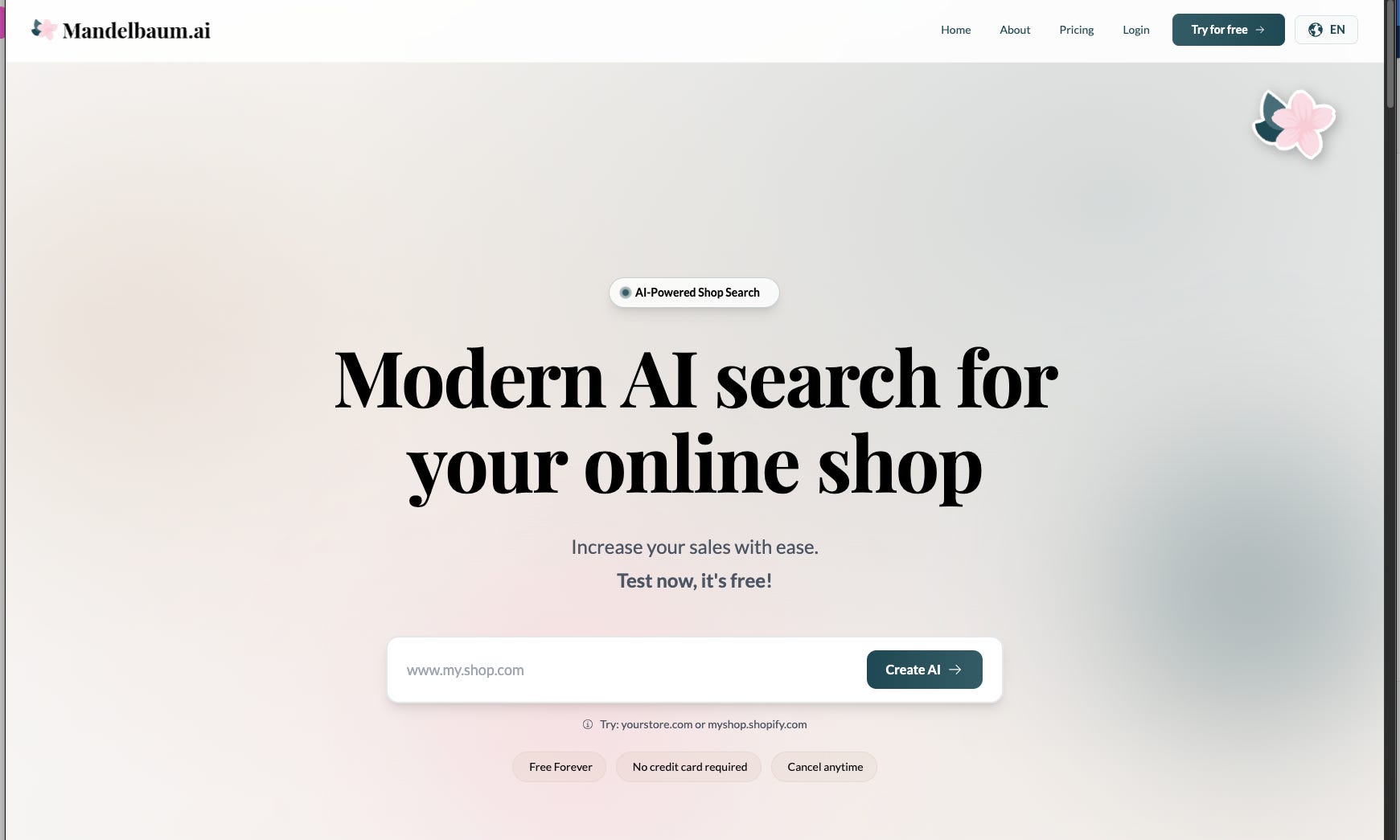
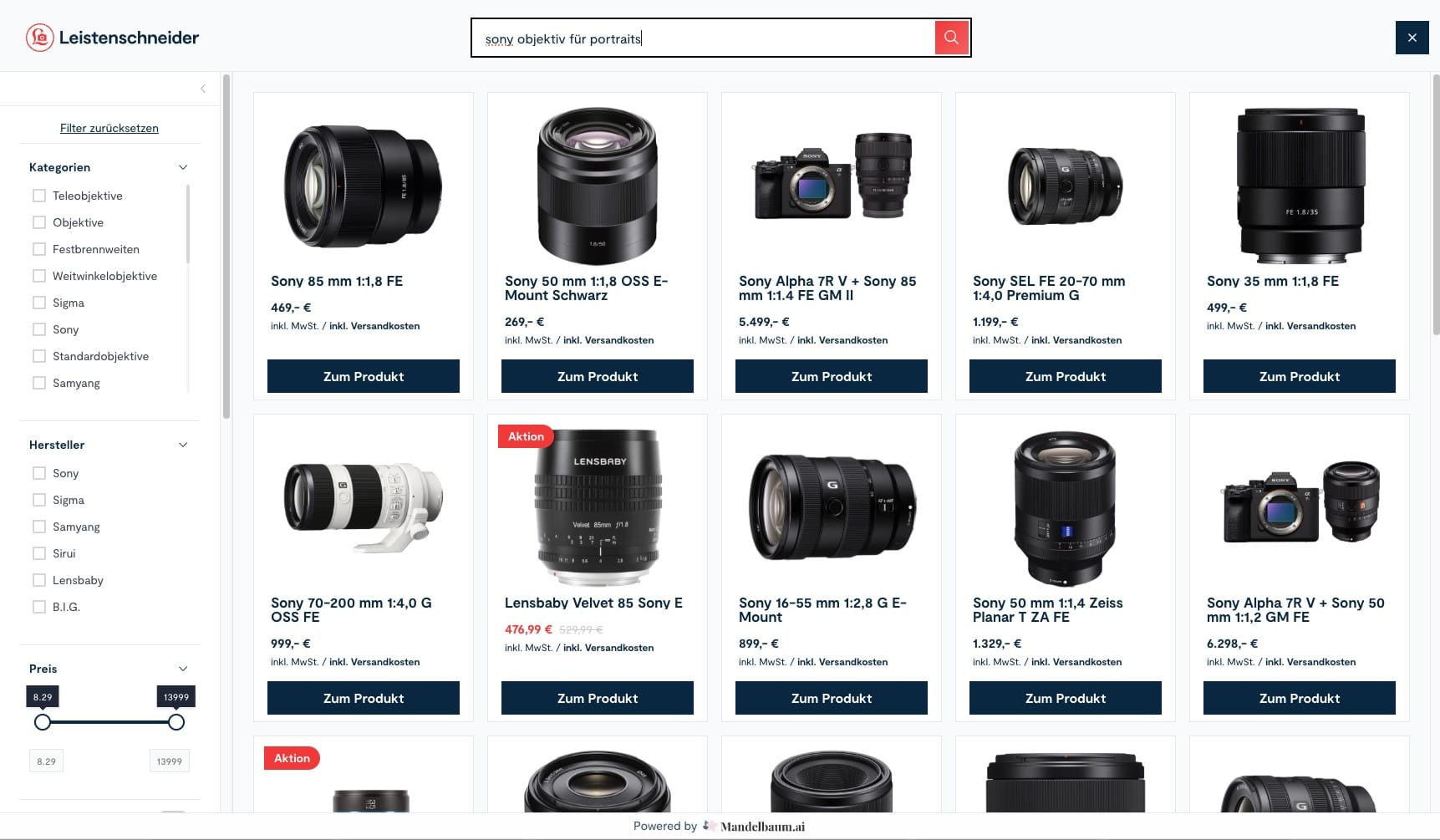
The product solves a problem every online shopper knows: You know what you need, but you don’t know what the product is called. “Customers don’t have to search by keywords anymore. They don’t have to know the product name”, Carl explains. His favorite example: In a fashion shop, you type “I need a piece of fabric so my legs don’t get cold in winter” – and you get warm trousers. This works because an AI model understands the meaning of the query in the background and matches it against product descriptions, instead of looking for exact keyword hits.
Mandelbaum integrates in three ways: through a crawler that walks the shop on its own, through a Shopify app, or through a product feed. Zero configuration to start, full configuration depth for power users. The flagship customer is Foto Leistenschneider with around 25,000 articles on Shopware. Carl quotes the owner in the episode, and the line captures the USP perfectly:
“Your search is so good that I wouldn’t recommend it to any of my competitors, because it’s our unfair advantage.”
Tech Stack: Own LLM, Own GPU Server, All in Germany
Mandelbaum is not just an OpenAI wrapper. Carl and Tim deliberately moved away from external API providers and now run their own open-source model, fine-tuned for e-commerce, on their own GPU server. The vector database comes from Qdrant in Berlin. Everything is self-hosted on Kubernetes, the entire stack lives in Germany. The switch wasn’t ideological, it was pragmatic: faster, better, cheaper – and an additional sales argument for German Mittelstand shops whose data should not leave the country. “We want to have technology in Europe, AI companies in Europe that can compete with the big players”, Carl says.
Pricing Against the Market: Pay Only on Conversion
When it comes to the business model, Mandelbaum takes a different path than most SaaS players in the search space. The standard is usage-based pricing, billed on API calls or search volume – with the side effect that shops can suddenly receive four- or five-figure surprise bills on Black Friday. Mandelbaum bills on conversions instead, in fixed tiers. Meaning: If the search leads to a purchase, it gets paid for. If it doesn’t, it doesn’t cost anything. That’s a model only someone confident in their search converting better than what shops had before will offer.
Sales Through the Agency Network and Run Clubs
The first customers came through the Dynabase agency network. After that, trade shows like the E-Commerce Berlin Expo and Didacta, with reach far beyond the booth conversations themselves. One of the more unusual sales situations: a chat at a run club hosted by Ryzon, a premium triathlon and running brand. Carl ended up in conversation with someone on the way to the toilet – Ryzon became a pilot customer. This mix of systematic network-driven sales and serendipitous acquisition runs through the entire episode.
Customer vs. Complainer
One of the key lessons from the spin-out is captured in a phrase Tim keeps using: customer vs. complainer.
“There are lots of problems and we all spend the entire day complaining. The real question is: which problems are you actually willing to pay money for?”
In the agency world, the customer arrives with a finished requirements document. In product, you have to figure out yourself which problem is big enough that someone will reach for their credit card. That’s why Mandelbaum doesn’t build features just because someone complained about them at a conference – they build them when a paying customer concretely needs them.
What I Learned in This Interview
A clean spin-out is possible if all parties are treated fairly. Carl and Tim structured the spin-out so that the operators hold the majority and the agency founders stay involved as angels. Both sides benefit long-term.
Running your own LLM is feasible at bootstrapper scale. Mandelbaum hosts its AI model on a GPU server in Germany and is faster, better and cheaper than the OpenAI wrapper they started with.
Conversion-based pricing is a strong USP. Removing Black Friday surprise bills from the SaaS conversation gives an immediate sales advantage – but it requires a product that genuinely converts.
The full episode is now also on YouTube (German only):
Takeaways for Founders
Spin-outs can be structured fairly for everyone involved – clear majority ownership and well-defined roles between operators and investors are key.
Owning your AI infrastructure is feasible for small teams – a self-hosted GPU server can beat OpenAI on speed, quality and cost when the use cases are clear.
Pricing against the market standard can be a USP in itself – conversion-based billing removes risk from the customer and creates differentiation in sales.
Customer vs. complainer as a roadmap filter – not every requested feature is one someone will actually pay for. The credit card prioritizes the roadmap.
Sales happens outside the pipeline too – trade shows, agency networks and serendipitous run-club conversations bring early customers when the product convinces.
Happy Bootstrapping is a German podcast where I interview bootstrapped founders, indie hackers, and solopreneurs about their startup journeys.
Over the years, I’ve connected with many successful entrepreneurs who have built e-commerce shops, SaaS platforms, mobile apps, content businesses, or hybrid models.
Furthermore I am a bootstrapper myself and growing my DevOps-as-a-Sercice and Web Operations Company “We Manage”.