

Silvano D'Agostino didn't study computer science – he studied organizational psychology. His background isn't cloud architecture or machine learning; it's understanding how people deal with change. That foundation shapes everything about Kambria, the Berlin-based consultancy he co-founded with David Henkel and Friedrich Staufenbiel in September 2024.
In episode 166 of Happy Bootstrapping, he explains why AI transformation is fundamentally a human problem – and what that means in practice when you walk into a mid-sized manufacturing company.
This is a summary of Episode 166 of the “Happy Bootstrapping” Podcast (German).
What Does Kambria Actually Do?
Kambria is part of the b.telligent group and positions itself as a full-service partner for AI transformation in the German Mittelstand. In practice, that means three things: giving organizations broad access to AI tools, training people to actually use them, and identifying processes that can be meaningfully improved with AI.
What sets Kambria apart is the composition of its founding team: the technical depth comes from b.telligent, one of Germany’s larger data and software consulting firms. The transformation and change management expertise comes from Silvano, who spent eight years guiding mid-sized companies through growth processes. That combination makes it possible to go deep on technical implementation while genuinely bringing people along.
The Real Problem with AI Adoption
The obstacles to AI transformation in mid-sized companies are more nuanced than most assume. Silvano describes a split picture: at the decision-maker level, there’s often an inflated sense of what’s possible – driven by LinkedIn posts about AI agents that sound more like science fiction than day-to-day reality. At the same time, there’s a complete blind spot for simple, low-threshold measures that produce immediate results.
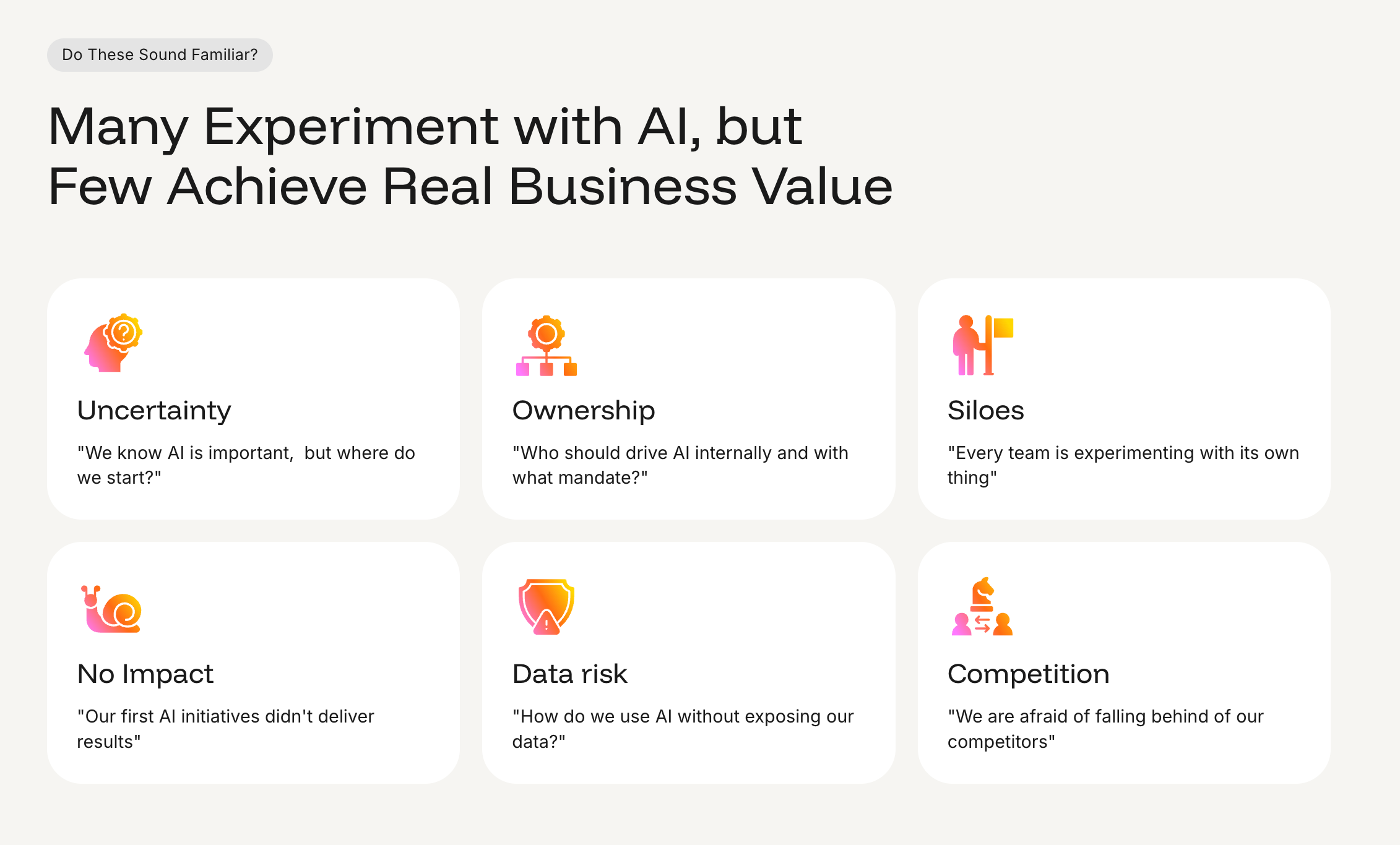
On the operational level, it’s often the reverse. Some employees are already far along, quietly using AI tools with personal accounts, shared licenses, or informal subscriptions. Others are starting from zero and bring real skepticism. Kambria has to work with both.
“In roughly a quarter of cases, the process improvements we map out have little or nothing to do with AI.”
That sounds counterintuitive, but it makes sense. When people start thinking about their own processes from the perspective of an AI, they discover inefficiencies that don’t need AI at all. The value isn’t always the tool – it’s the change in thinking.
Pioneers, Not Champions
Kambria’s approach is deliberately bottom-up. In most projects, the team starts with a small group of employees who are motivated and know their own processes well. Silvano calls them pioneers rather than champions – because “champion” sounds too much like sales language.
These people don’t need to be technical. But they need process knowledge and openness to rethinking how things work. With them, Kambria builds early wins. Then those pioneers start sharing their small solutions with their teams – and that’s when momentum builds. Kambria uses that momentum to launch more centralized initiatives.
The Platform: Open Source as Strategy
Alongside consulting, Kambria operates its own AI chat platform built on open-source technology. This isn’t just a technical choice – it’s a strategic one. No per-user license fees, full data sovereignty, hosting in German infrastructure or at the client’s own site, and the ability to combine multiple models – from OpenAI to Mistral to locally hosted options – in a single interface.
For clients with sensitive data, this enables hybrid setups: general queries go through European APIs, high-sensitivity use cases run on local models. One example from the episode: an HR team running open-source models on an Apple Mac Studio.
30 Projects in 6 Months
Kambria became operationally active in October 2024. In the first six months, the team signed around 30 projects. The initial client base came from their own network – the platform was tested internally, contacts asked about it, and early testers became early customers.
Since then, Kambria has focused on two channels: strategic partnerships with companies in HR, change management, and related fields, and physical offline events in regions with strong Mittelstand density. Not the major cities – the B-tier locations where competition is lower and the audience is more accessible.
Bootstrapped and Profitable
Kambria launched without external investors. The founders put in their own capital, and by early 2026, the company was running profitably. Silvano’s guiding principle: projects before people – only hire when the next contracts are secured.
Growth is expected to come primarily from the consulting side. The platform is a tool in the transformation journey, not a standalone SaaS product. Clients who work with Kambria get both: technology and guidance.
NEW: The full episode is now also on YouTube (German only):
5 Takeaways for Founders
AI transformation rarely fails because of the technology – it fails because people aren’t equipped or motivated to use it.
Shadow use of AI tools is present in almost every organization. Ignoring it means missing a critical signal.
Bottom-up approaches create more durable momentum than top-down rollouts. Motivated pioneers are worth more than reluctant users.
Open source as a platform strategy can be a genuine differentiator – especially when it aligns with clients’ data security and infrastructure requirements.
Events outside major cities often yield higher-quality leads than well-covered metropolitan markets.
Happy Bootstrapping is a German podcast where I interview bootstrapped founders, indie hackers, and solopreneurs about their startup journeys.
Over the years, I’ve connected with many successful entrepreneurs who have built e-commerce shops, SaaS platforms, mobile apps, content businesses, or hybrid models.
Furthermore I am a bootstrapper myself and growing my DevOps-as-a-Sercice and Web Operations Company “We Manage”.