

Michael Wirth has spent more than 40 years in the elevator industry, has built elevators across two continents and eleven countries, and today advises operators, property managers and planners independently through his firm Deutscher Aufzugsdienst. His son-in-law Stephan Wirth has been developing software for 30 years, has been self-employed for nine, and lives in Galicia in northwestern Spain. Together the two built EAS360, a SaaS platform that bundles the maintenance, inspection deadlines, quotes and costs of elevators in one place.
In episode 180 of Happy Bootstrapping, I spoke with them about how a private Excel sheet turned into a product, and why one simple market price comparison moves so much in this industry.
This is a summary of Episode 180 of the “Happy Bootstrapping” Podcast (German).
From a Crashed Excel Sheet to Software
There was no business plan at the start – just a linked Excel sheet. Michael used it to manage the elevators of his consulting clients, until the whole construction collapsed three days before a family visit. That was the exact moment the practitioner with the domain knowledge and the developer in the family came together.
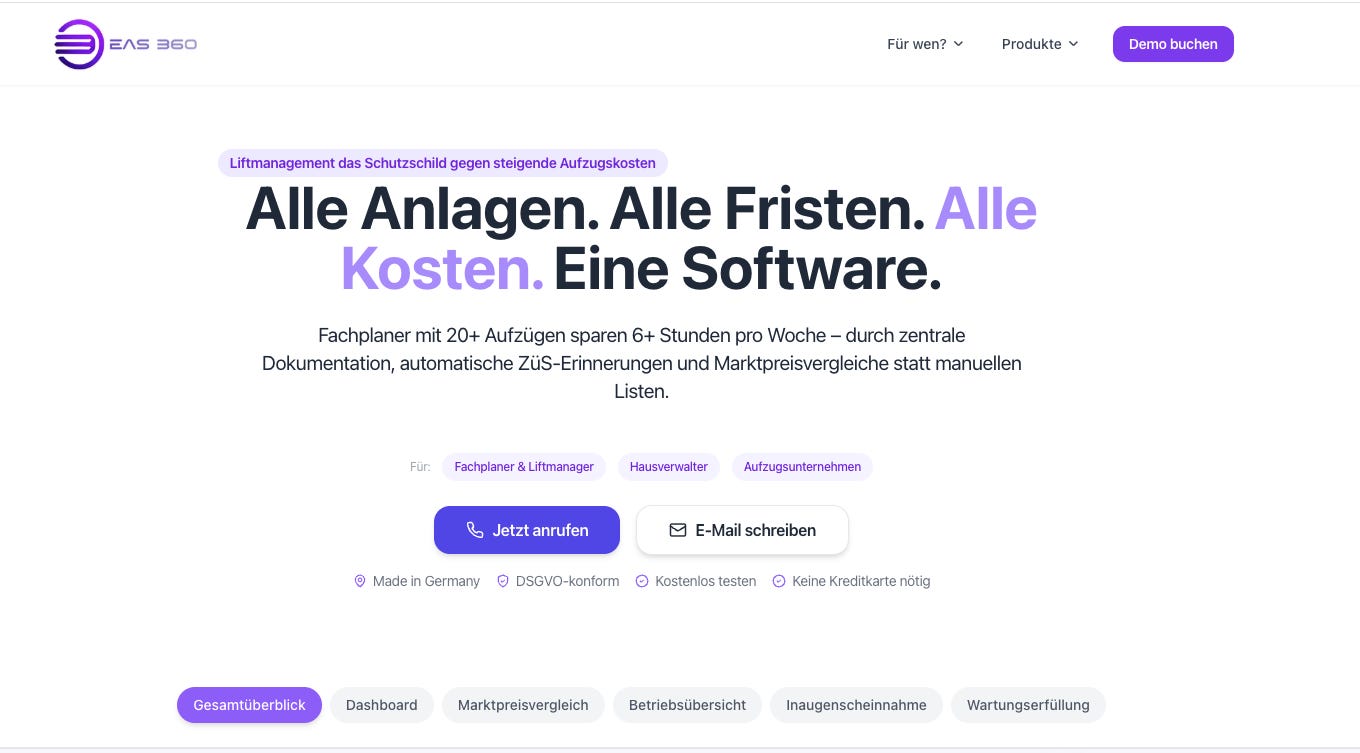
What began as a stopgap grew over four years into a real platform. What stands out is that the two never started from a startup mindset, but from a concrete problem of their own – and shaped it step by step into a product that now manages more than 320 elevators.
What EAS360 Actually Solves
Elevators are heavily regulated, maintenance-intensive and expensive. Inspection deadlines keep running, maintenance contracts renew automatically, and repair quotes land scattered across email and paper. EAS360 pulls all of this into one place: which unit was inspected when, which maintenance is due, which quote is on the table and what it costs. For operators and property managers who often look after dozens of units from different manufacturers, that overview alone is already valuable. Missed inspection deadlines, for instance, can get expensive and even carry liability risk – reason enough for many operators to switch. The real lever, though, sits elsewhere: in the costs.
The Market Price Comparison at the Core
Hardly anyone outside the industry knows what a repair or a maintenance job on an elevator should actually cost. EAS360 turns exactly that opacity into an advantage by making every quote entered part of a growing database and comparing it against the market average.
“So that anyone who has no idea about elevators can use the system and see: okay, this is actually the market price.”
Just how strong that effect can be, Michael illustrates with a single customer.
“The quotes coming in for this customer were over 600,000 euros. What we actually commissioned was only 325,000 euros.”
That is roughly 40 percent of running costs saved in a single year – not through some technical marvel, but through transparency. The fact that Michael works as an independent advisor with no ties to any manufacturer gives that promise the credibility it needs.
“And that’s the real help in this market – that you genuinely help people.”
Practitioner Meets Developer
The most compelling part of the conversation is the friction between the two roles. Michael brings four decades of implicit industry knowledge that does not translate neatly into software. Stephan has to turn that knowledge, from Galicia, into data models and interfaces – across borders, across generations, and across the gap between the workshop and the editor.
That the two are related by marriage does not make the collaboration easier, but it does make it more honest: feedback is direct, processes grow along with the product, and the family is team, test environment and corrective all at once.
Selling Into a Stubborn Industry
As clear as the value is, the sales side is hard. The elevator industry is considered extremely conservative, decision paths are long, and digital solutions are met with skepticism. Whoever sells here wins not with feature lists, but with trust and a demonstrable result. EAS360 therefore grows mainly through networks and personal recommendations rather than fast campaigns.
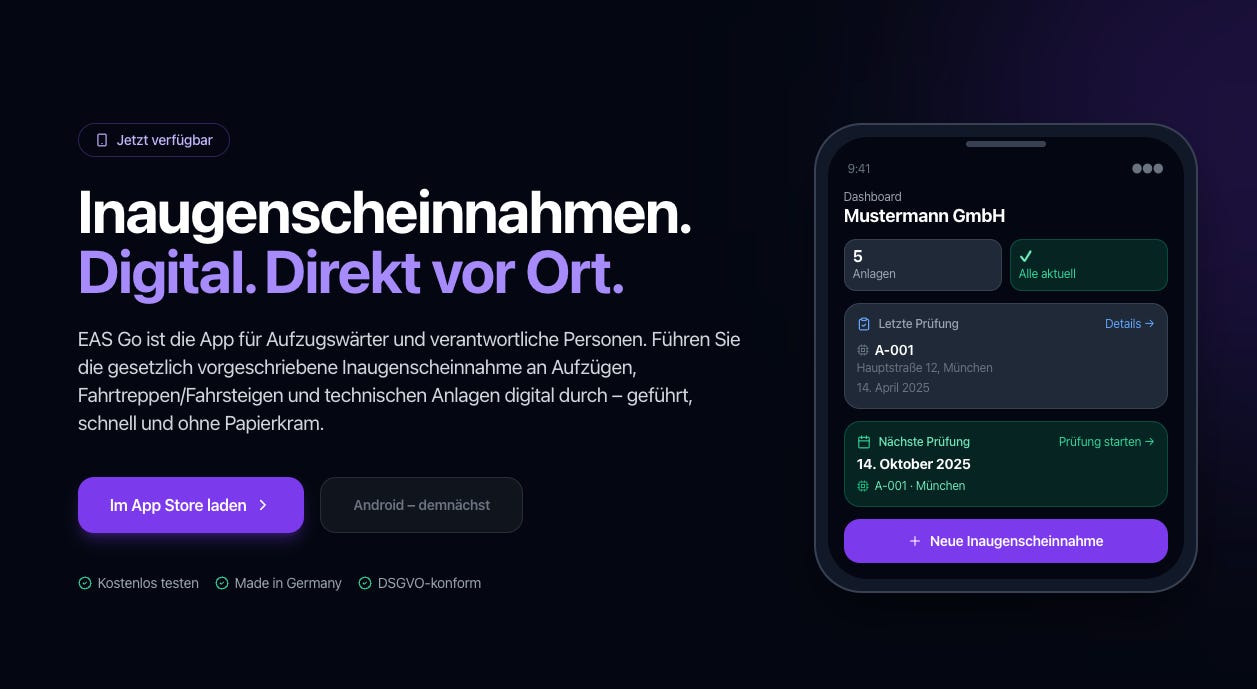
In parallel, the two keep expanding the product: with the new app EAS-Y 360, building caretakers can report faults and document visual inspections directly from a smartphone. A genuine IoT connection to the units is deliberately not there yet – first comes the value for the people who deal with the elevators every day, then the technology.
What I Learned From the Interview
What surprised me most was how little it sometimes takes to create real value in a stuck industry. No AI fireworks, no sensors on every unit – just consistently collected price data and a clean overview.
The second point is the division of roles: a domain expert who knows the problem inside out, plus a developer who implements it cleanly, is a surprisingly robust founding constellation. And third, EAS360 shows that a product is allowed to emerge from your own everyday life, entirely without the intention of “building a startup.”
The full episode is now also on YouTube (German only):
Learnings for Founders
Solve your own problem first. The crashed Excel sheet was the most honest product-market-fit test imaginable.
Turn opacity into a feature. Where nobody knows the real prices, a simple comparison database becomes a strong USP.
Find the right division of roles. Domain knowledge plus development skill beats two generalists.
Do not underestimate conservative industries. Sales are slow, but the willingness to pay is there once the value is concrete.
Build in the right order. Value for the users first, then the demanding technology like IoT.
Happy Bootstrapping is a German podcast where I interview bootstrapped founders, indie hackers, and solopreneurs about their startup journeys.
Over the years, I’ve connected with many successful entrepreneurs who have built e-commerce shops, SaaS platforms, mobile apps, content businesses, or hybrid models.
Furthermore I am a bootstrapper myself and growing my DevOps-as-a-Sercice and Web Operations Company “We Manage”.