

In episode 176 of Happy Bootstrapping, I talk with Henrik Roth, Co-Founder and CMO of HappySupport, a self-updating help center for SaaS companies. Together with co-founder Niklas Gysinn (CEO and CTO), Henrik is building a tool that connects to the codebase and detects after every commit which documentation has gone stale.
HappySupport was founded in 2025 and financed through a €200,000 pre-seed round – entirely without giving up equity. Right now there are first paying customers and five pilot customers, but no product market fit yet.
This is a summary of Episode 176 of the “Happy Bootstrapping” Podcast (German).
From Wooden Accessories to a Third Startup
Henrik is a serial entrepreneur, and HappySupport is his third company. He started with BeWooden, a brand for wooden accessories that he grew from zero to a seven-figure e-commerce business. After that, he co-founded neuroflash, one of the best-known AI content platforms in the DACH region. For five and a half years he was responsible for marketing and growth there, scaling the product to more than half a million website visitors per month.
After that long chapter came the cut: since March, Henrik has been putting all his energy into HappySupport. What’s striking is that a second big success doesn’t make the third start any easier. Henrik is deliberately beginning again from scratch – with few customers, no finished business model, and a willingness to talk openly about this unfinished phase.
The Problem: Software Docs Are Almost Always Outdated
The starting observation is simple and applies to nearly every SaaS product. Thanks to AI, digital products evolve faster than ever before, and help centers are constantly lagging behind.
“What we’re solving, in essence, is the problem of software documentation that’s no longer up to date.”
Outdated docs have two expensive consequences: more support requests, because users can’t help themselves, and worse answers from service chatbots like Fin that are built on exactly these knowledge bases. That’s why HappySupport connects to the codebase via GitHub and detects after every commit what needs updating in the help center.
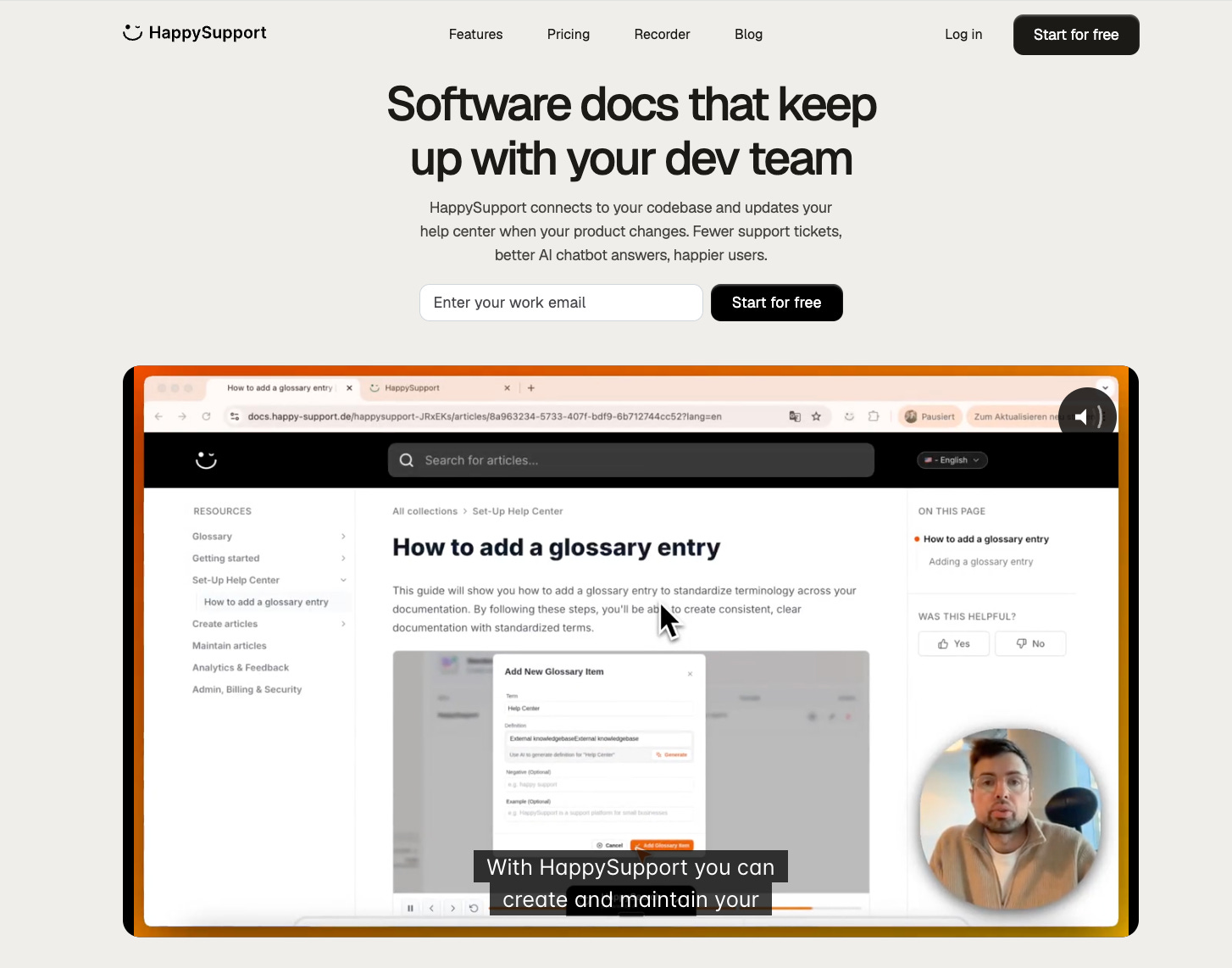
The real USP sits in the recorder. It doesn’t just capture static screenshots but DOM elements and CSS IDs – so the tool actually understands how the frontend is built. From a single click-through, such as “how to reset my password,” it produces an animated step-by-step guide for the docs that can simultaneously be embedded as an in-app tour in the software. To make sure AI handles content well, the team built six article templates – FAQ, troubleshooting, reference – and optimized the docs much like a website.
€200,000 Pre-Seed – Without Giving Up Equity
HappySupport is financed through the BW Pre-Seed program. The bulk comes from a loan provided by L-Bank, plus a convertible loan from an angel – €200,000 in total, without Henrik and Niklas having to give up any shares. On board as business angels are Fabian Silberer, co-founder of sevDesk, and Benedikt Brand, CEO of Flip.
For Henrik, the deciding factor wasn’t the money but the network. Fabian is exceptionally well connected through numerous software investments and made intros right away. Through Benedikt, one of the first paying customers even came in. Especially at the beginning, that’s decisive, Henrik says: win the first customers, gather their feedback, and sharpen the product based on it.
Marketing Through LLM Visibility
As an unknown brand, Henrik bets on a channel he knows from neuroflash that is now taking on a new dimension: visibility in large language models. His first inbound demo call didn’t come through Google or ads, but because an AI recommended HappySupport.
Henrik builds this visibility in from the start. AI ideally wants a question answered in three sentences, not in a 2,000-word article. That’s why the content is modular and structured – at its core the same discipline as SEO, just with AI chatbots as the target audience.
Product Market Fit First, Then Growth
Henrik brings his most important learning from neuroflash. At peak times, revenue there grew substantially month over month, while monthly churn was in the double digits.
“It’s nice in the moment to grow that fast, but for me those are always little warning signs. You don’t have a sustainable business model then.”
At HappySupport, he therefore watches the honest signals: real lock-in and customers who choose the annual plan over the monthly one. Product market fit first, then a repeatable acquisition strategy – in that order. The AI-first approach fits with this: a big VC story isn’t on the table right now, all the energy goes into the product, and with AI you can achieve a lot even with a small team. His bar for quality stays high: “If you use your own product really well and truly value it, then I think you also have a good product.”
What I Learned from the Interview
A second success doesn’t make the third start easier. Henrik scaled neuroflash to half a million visitors and still begins again from zero with HappySupport – including the open phase without product market fit.
Business angels often bring more network than money. Warm intros and the first paying customer via an angel are worth more in the early phase than the check.
LLM visibility is becoming its own marketing channel. When your first lead comes from an AI recommendation, it pays to structure content for it from day one.
Learnings for Founders
Build software docs that move with the product – outdated content creates support load and bad AI answers.
Choose business angels for their network and access, not just for their capital.
Watch the right metrics early: low churn and lock-in say more than fast growth.
Structure content modularly and to the point so AI chatbots can reproduce it well.
Consider equity-free programs like BW Pre-Seed as a way to start without selling shares.
Use your own product daily – it’s the most honest quality test.
Happy Bootstrapping is a German podcast where I interview bootstrapped founders, indie hackers, and solopreneurs about their startup journeys.
Over the years, I’ve connected with many successful entrepreneurs who have built e-commerce shops, SaaS platforms, mobile apps, content businesses, or hybrid models.
Furthermore I am a bootstrapper myself and growing my DevOps-as-a-Sercice and Web Operations Company “We Manage”.