

Dr. Marvin Behrendt is a coach, trainer, speaker and author known as the Feedbackdoktor. A working-class kid with a doctorate, he came to entrepreneurship via Schalke 04 and more than a decade as a top-level executive at ThyssenKrupp – and deliberately self-published his first book, even though a publishing contract was already on the table. It’s a story about visibility, control and the long game behind a book project.
This is a summary of Episode 178 of the “Happy Bootstrapping” Podcast (German).
From corporate career to going solo
Marvin’s path is anything but linear. After stints on the agency side and in marketing at Schalke 04, he spent more than ten years at ThyssenKrupp, most recently as an executive in the steel leadership team – among the top 270 of roughly 30,000 employees. In parallel, he earned a doctorate on identity-driven brand management in professional football, based on a fan survey with more than 6,000 participants.
Two years ago, he made the cut. He planned the transition soberly, using a severance plan, parental leave and a German start-up grant – not a leap into the cold, but a deliberately cushioned start. Since then, the Feedbackdoktor has rested on three pillars: a coaching and consulting business around leadership and change, the book, and an app idea.
Feedback as a business model
At the center sits the topic that gave him his name. Marvin helps individuals, teams and entire organizations make feedback clearer and more effective – through coaching, training, workshops and corporate packages. His understanding of good feedback has little to do with cotton-wool rhetoric.
“Empathy is not fabric softener. Empathy is very clear, and it’s very hard.”
He builds his reach almost entirely on LinkedIn. He has gathered around 25,000 followers there and, by his own account, belongs to the German “impressions millionaires” with seven-figure reach. He uses that visibility as a social-selling funnel – while making clear that the visible success is only a fraction of the work.
“Inbound is just the tip of the iceberg.”
The road to his own book
That very visibility led to a moment many experts dream of: a publisher approached him with an inbound request. The normal route runs the other way – you write a proposal, knock on doors and usually collect rejections. Marvin had the opposite, and still said no, because two clauses in the contract undermined the trust he needed.
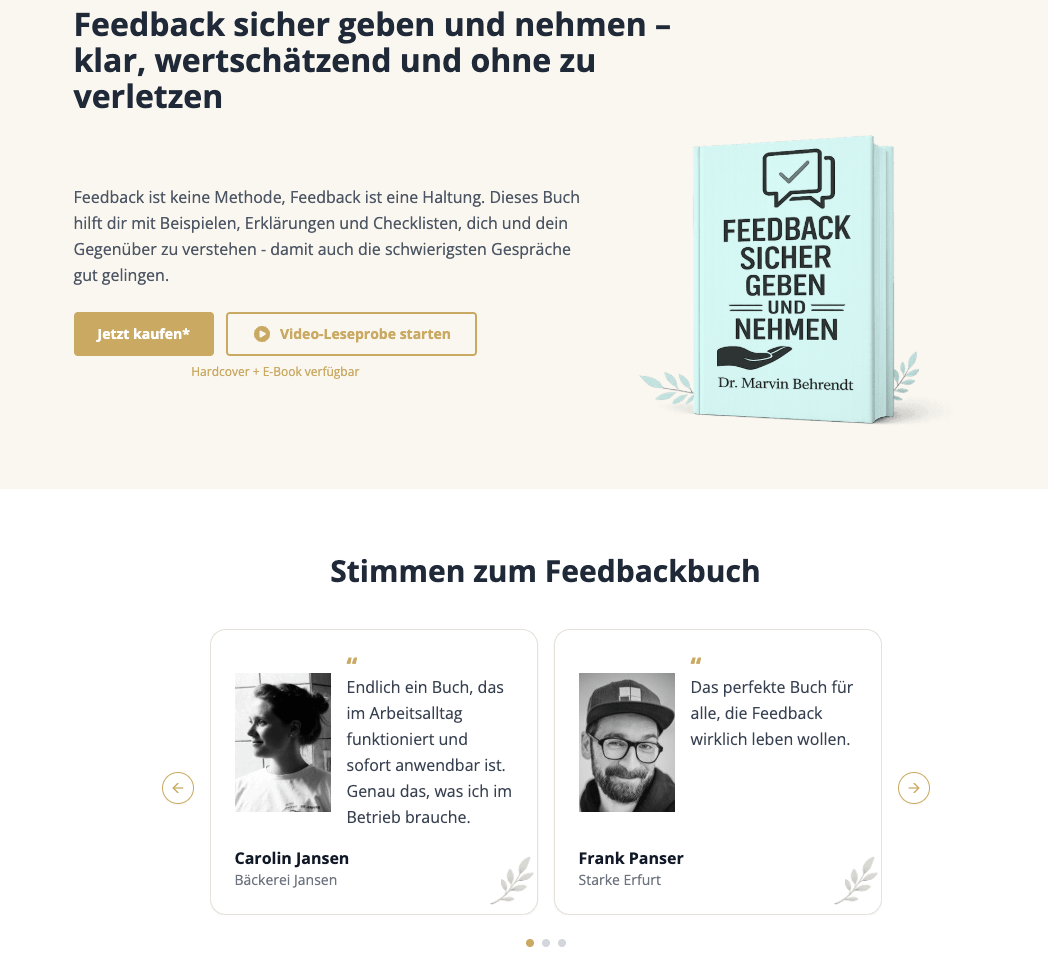
Instead, he pushed the book “Feedback sicher geben und nehmen” through himself as a bootstrapping project, self-published via Amazon. The result: number two in Amazon’s personnel-development niche, with around 90 percent of sales in print. While writing, he relied heavily on AI – for research, keyword optimization and product content – without letting it take the content out of his hands.
“Every single word you read in the book was written by me. The AI did not write it.”
He affectionately calls the AI “the worst employee on my team” – useful, but often headstrong. He stays realistic about his goals, too: 40 books sold per month by the end of the year already counts as a major success for him, with the real leverage sitting in corporate packages. He frames the royalties just as soberly – for a debut work, in the usual single-digit percentage of the net sales price.
He also creates visibility through PR: at deutsche-startups he pitched not a single guest article but an entire series, honestly showing how a book project really plays out when bootstrapped – cliffs included, rather than the polished success story.
From an idea to a platform
The third pillar is still under construction. Originally conceived as a feedback app, the idea has grown into something bigger: an AI-powered “HR department for companies without an HR department” – from recruiting through onboarding to offboarding, designed for the likes of a 25-person trade business. It’s being built with a partner who orchestrates AI agents, while Marvin himself remains the bottleneck. The beta is meant to be ready by the end of the year.
That he manages all of this as a solopreneur – alongside four children in a patchwork family and a fresh advisory-board mandate since the spring – makes the balancing act all the more remarkable. What drives him is less a fixed revenue target than the fact that, today, he gets to choose his own topics.
What I learned in the interview
Visibility is groundwork, not luck. Marvin’s publishing offer didn’t come out of nowhere; it was the result of years of consistent presence on LinkedIn.
Control can be worth more than a publisher’s logo. A rejected contract is not a missed success if the terms don’t fit your way of working.
AI is a tool, not an author. Marvin uses it intensively and still keeps full responsibility for every word – a healthy middle path between hype and rejection.
The full episode is now also on YouTube (German only):
Lessons for Founders
Build your platform before you need it: reach accumulated over time makes later opportunities and sales almost effortless.
Say no even to dreams when the terms are wrong: trust beats prestige.
Think in packages, not single sales: for expert products, the biggest leverage often sits in the B2B business.
Plan your exit soberly: a severance plan, parental leave and a start-up grant can cushion the jump.
Use AI honestly: strong as a research and production aid, to be handled with care as an author.
Do you have questions or feedback about the podcast?
Feel free to email me or reach out on LinkedIn. I’d really appreciate it if you took a moment to rate the podcast or simply recommend the newsletter to others – thank you so much!
Happy Bootstrapping is a German podcast where I interview bootstrapped founders, indie hackers, and solopreneurs about their startup journeys.
Over the years, I’ve connected with many successful entrepreneurs who have built e-commerce shops, SaaS platforms, mobile apps, content businesses, or hybrid models.
Furthermore I am a bootstrapper myself and growing my DevOps-as-a-Sercice and Web Operations Company “We Manage”.