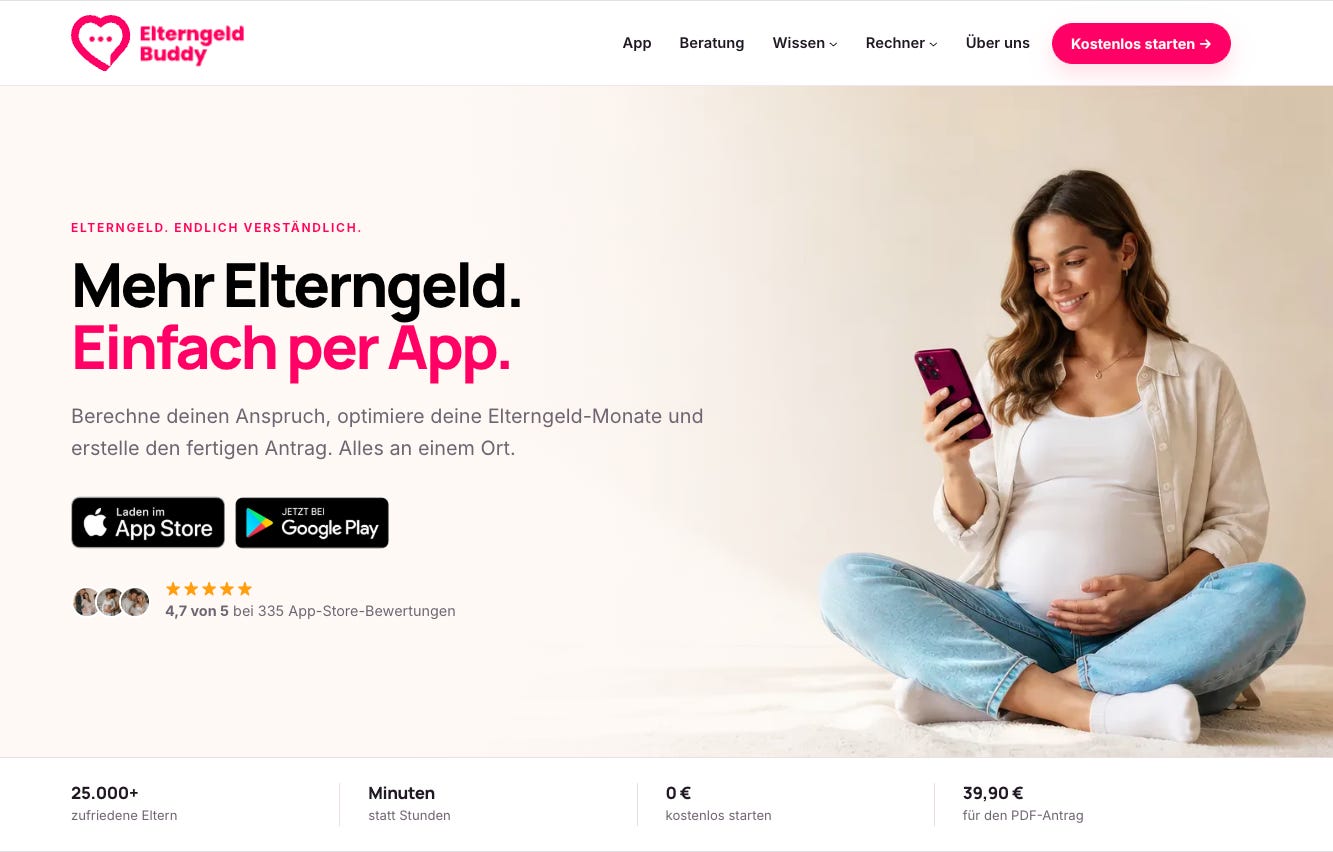
Paulina Köpp co-founded Elterngeld Buddy with her husband Ingo in Solingen. Elterngeld is Germany’s parental allowance, the money parents receive from the state while they stay at home with a new baby. The app guides parents through the long application form in a chat and has reached around 25,000 downloads in just under ten months. Both founders work on it full time, with no employees and no investors.
When their first daughter was born, Paulina and Ingo were both employed and also ran a small side business. For parental allowance, that counts as mixed income, which makes the application much harder. That experience led to a simple question: there are apps for tax returns, so why not for parental allowance?
The idea sat on the shelf for a while. Throwing everything in with a baby only a few months old was not an option for either of them. The decision finally came on a walk:
“Let’s just do it. Let’s just give it a try.”
The company was officially founded in October 2024, with Paulina working on it full time from the start. Ingo quit his job in May 2025. Paulina has a background in design and marketing, Ingo is a software developer.
“Or you regret it the other way, because you never tried and never get an answer to what would have happened.”
600 consultations before the app
The original plan was to offer a few consultations on the side and build the app in the background. Then one or two videos took off on Instagram, and requests came in every minute. Paulina did consultations until 2 pm, picked her daughter up from nursery and carried on from 6 pm to 9 pm. In one year she ran more than 600 paid consultations.
“We actually didn’t spend a single cent on advertising for the consultations.”
In a survey, 34 per cent said they had come through a recommendation. There was no referral scheme. At some point the couple deliberately offered fewer slots each month to free up time for the app. What they learned in those conversations is now built into the product: there are three, four or five cases that keep coming up.
How the app works
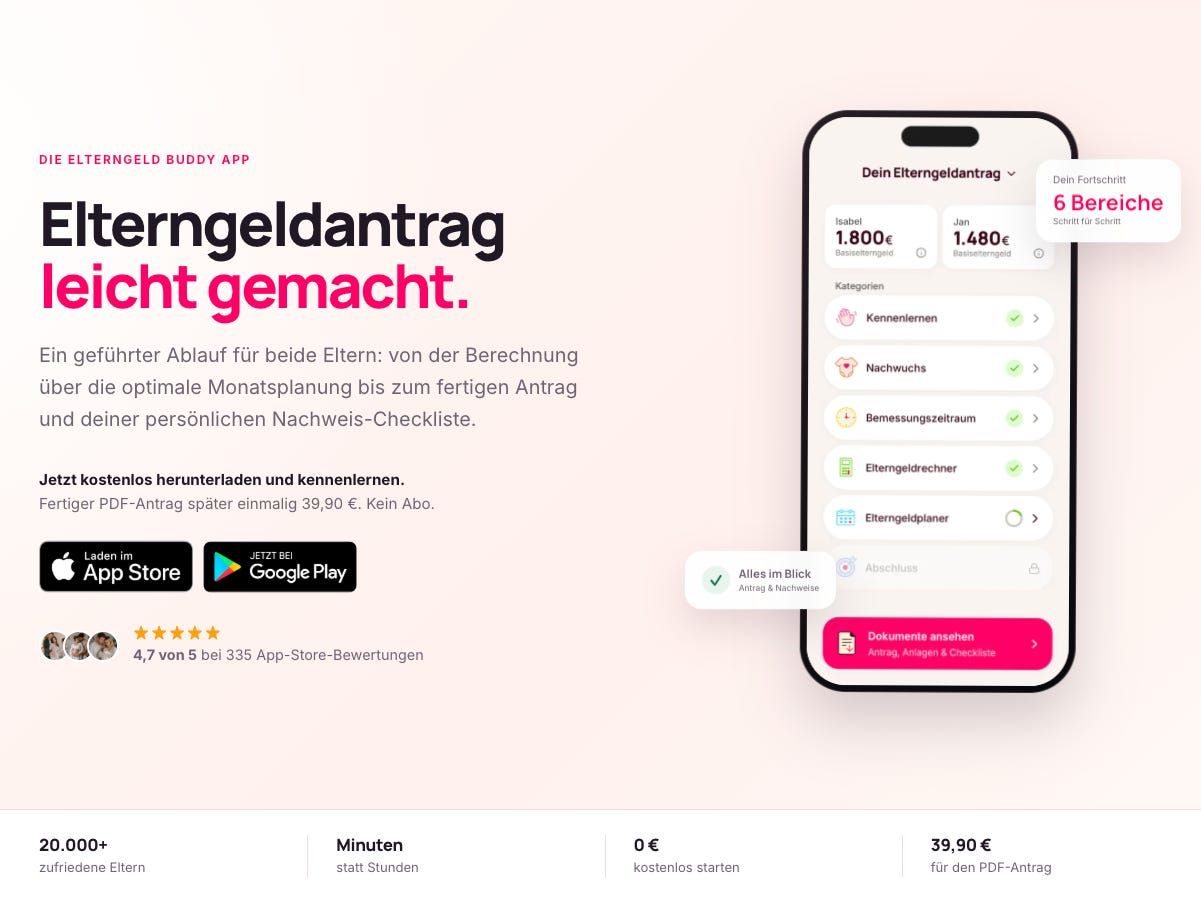
The application is split into six categories, three of them free. They cover things like the reference period, the months used to calculate the allowance. For some parents with several children, that period lies up to six years back. Unlocking the rest costs €40, including a planner, a parental allowance calculator and a personalised checklist.
There is no AI in the app so far. Ingo built his own flow builder in which questions and answers are predefined. Parents only type in personal details. Everything is hosted in Germany, and the CRM behind it is built in-house too.
“We didn’t want to just ship the data off to other servers.”
Across all users, conversion is 12 per cent. Among parents whose child has already been born, it is around 29 per cent. Consultations of 20 or 60 minutes are still available, because emails and DMs would otherwise take even more time.
From a quick reel to Meta Ads
The biggest boost came from a reel Paulina filmed in passing, about why two years of parental leave are worth it. The account had around 1,000 followers then.
“Overnight, 3,000 followers came in through that reel.”
Within a week it was around 10,000. Paulina thinks it helped that Instagram treats the account like a creator.
“Companies have an incredibly hard time getting organic followers or any interaction at all.”
For the app, organic reach is not enough, because the margin per customer is much smaller than for a consultation. Today Meta Ads is the most important channel, alongside recommendations. Midwives can pass on a discount code through a partner programme.
ChatGPT, regional forms and doing it alone
Every week or two, Paulina tests how far ChatGPT gets with parental allowance. Most recently it planned twelve months of the basic allowance followed by twelve months of the extended version, which the rules do not allow.
“As things stand, some wild stuff comes out.”
Then there is German federalism. The law applies nationwide, but individual federal states issue their own forms. Even the team behind the nationwide standard form found that confusing.
There were talks with investors, but the couple said no. They funded the company from savings, lived on Ingo’s salary for the first half year and then spent a year on the North Rhine-Westphalia founders’ grant of €1,200 per person. Today they pay themselves a small salary.
“We really wanted to know what we could achieve on our own.”
What I learned in the interview
Consulting before building pays off. The 600 conversations showed Paulina which cases really come up. Without them, she says, the app would not be where it is today.
A cheap product needs different channels. Instagram and recommendations were enough to fill 600 consultations. A €40 app needs paid advertising.
AI is not always the answer. For a form with legal consequences, a guided flow with fixed answers is more reliable than a chatbot that says something different every time.
Full Episode on YouTube (German)
Learnings for founders
Start with a service and learn from it before you build the product.
Throttle demand on purpose when it keeps you from your real goal.
Post content that genuinely helps, not just content about your product.
Look for partners who reach your audience early, like midwives.
Build a financial cushion before you jump and check which grants are available.
Only take investor money if it fits your own vision.
Thanks for reading Happy Bootstrapping Newsletter! Subscribe for free to receive new posts and support my work.
Over the years, I’ve connected with many successful entrepreneurs who have built e-commerce shops, SaaS platforms, mobile apps, content businesses, or hybrid models.