

Christian Häfner co-founded FastBill in 2011 and has run Happy Coffee, an online coffee retailer with a large base of subscription customers, since 2016. After teaching himself to code with AI, he first rebuilt his shop system and then created Rechnungskit, software for e-invoicing, tamper-proof archiving under the German GoBD rules and DATEV export for tax advisers. More than 3 million euros in payments now run through it.
This is a summary of Episode 196 of the “Happy Bootstrapping” Podcast (German).
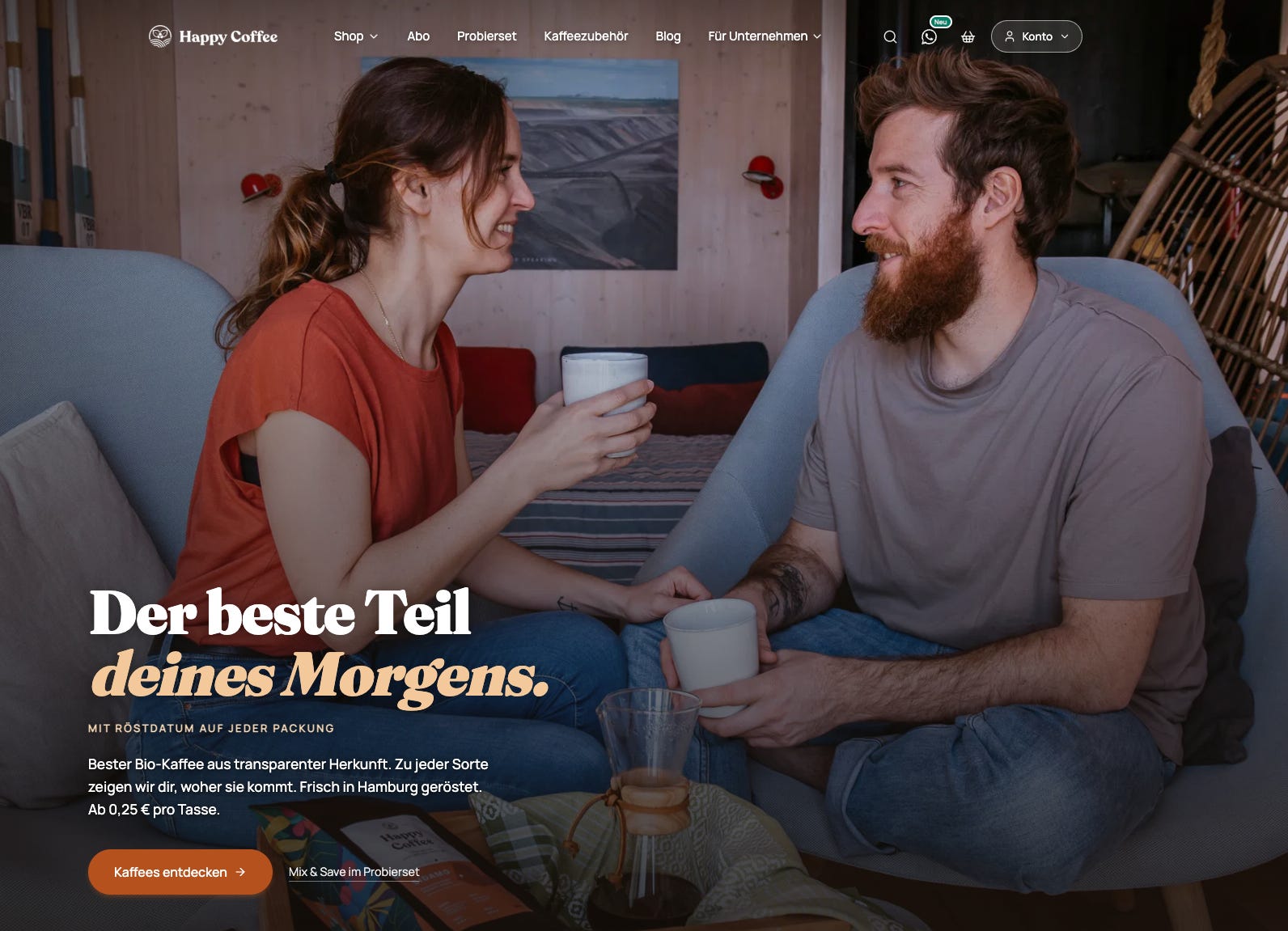
A coffee shop that runs almost without him
Happy Coffee has barely grown since our first conversation in episode 10. Revenue is still below one million euros a year. That does not bother Christian, because the shop hardly needs him any more.
“I do it more or less on my own. It has become a fully automated business.”
He has no employees. Since 2018 he and his wife have lived off the business, and above all it buys him one thing: time to build something new. Rechnungskit was created during a phase in which, by his own account, he sat at the computer practically full time, without anyone having to pay for those hours.
Learning to code with AI
The journey started with a warning letter. A German data protection authority took action over the US data transfers involved in running on Shopify, so Christian moved to a self-hosted WooCommerce setup with a third-party subscription tool he was never really happy with. At FastBill he had never been the technical co-founder. This time he wanted to understand things himself.
“My actual goal was to learn to program with AI.”
For a year he wrote code line by line with Cursor, learning about frameworks, infrastructure and security along the way. With Claude Code things moved considerably faster. After one year and nine months he switched to his own system at the end of January 2026 and migrated around 1,000 subscriptions, including the payment mandates at Mollie. The aim was that no customer would notice anything. These days he commits code for Happy Coffee only every couple of weeks.
Rechnungskit: payment first
His own bookkeeping turned into the next product. Christian had been using Billbee for invoices and Accountone for reconciliation, but matching payments cleanly to orders and fees remained manual work. His tax adviser kept coming back with questions.
“Payment first, that is my approach with Rechnungskit too.”
Rechnungskit starts with the payment, looks for the matching order, decides based on country, B2B or B2C and VAT ID which invoice is required, and archives it in a tamper-proof way on Hetzner.
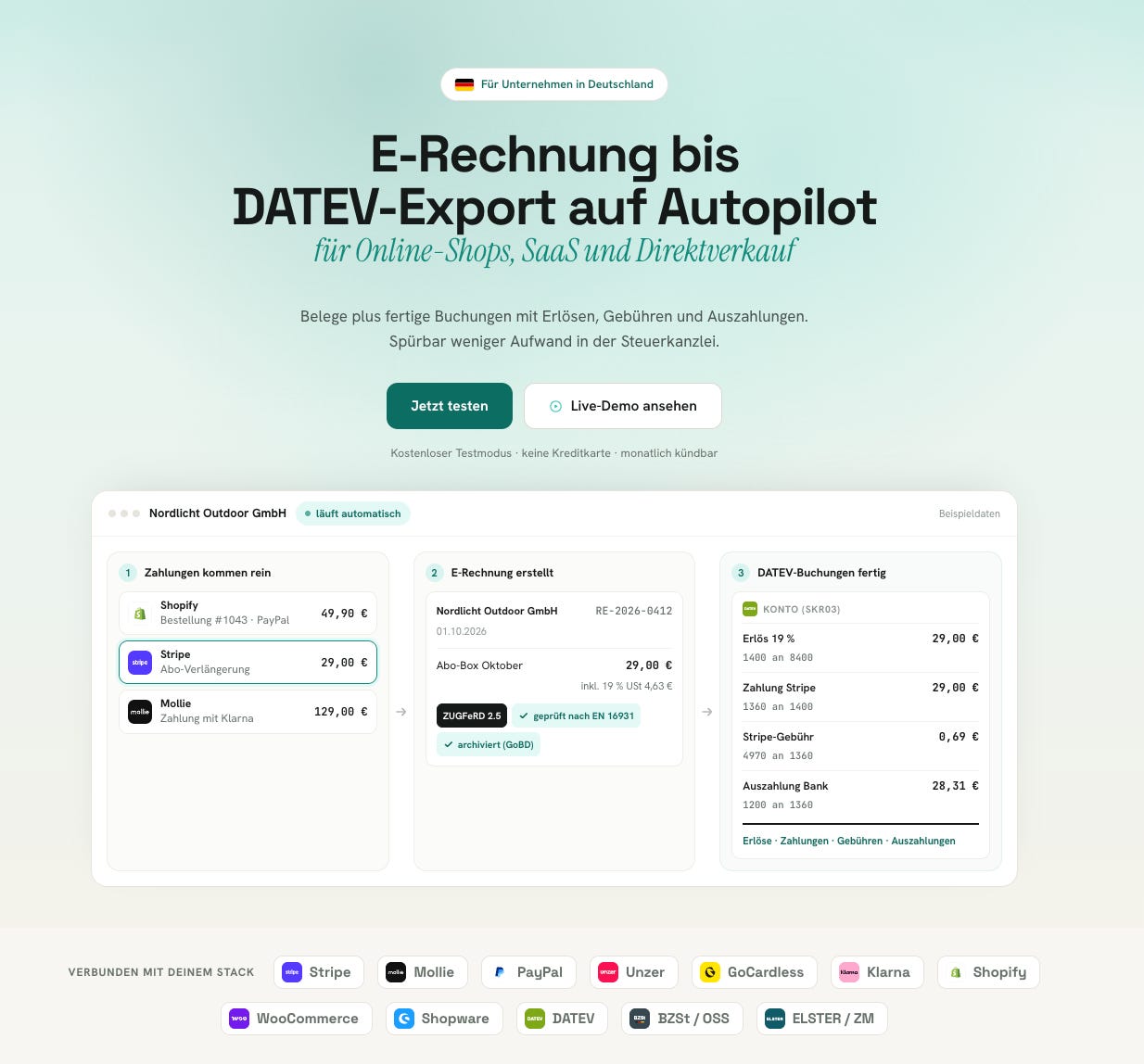
After the first exports, the questions from his tax adviser stopped. Since August the software has been open to everyone. The very first revenue was 60 cents, which Christian deliberately did not defer so he could test his own billing with a real customer. Pricing starts at 15 cents per invoice plus a 9 euro base fee and gets cheaper with volume.
E-invoicing is becoming mandatory for B2B transactions in Germany in stages, and many small shops are only now realising that even a coffee order placed by a company counts as B2B. Christian sees the change as an opportunity: the structured XML file becomes the actual invoice, while the PDF is just the human-readable view.
LinkedIn, comparison pages and a European stack
So far Christian has won customers exclusively through LinkedIn. He posts one to three times a day and relies on repetition, so that the name Rechnungskit comes up whenever someone thinks about e-invoicing. In parallel he builds comparison pages against tools such as sevDesk, Billbee and Accountone, showing which part of the process each one covers.
New features take a few hours. When I recommended AhaSend to him as a European email provider, the integration was live the same afternoon, complete with concept, tests and a security check.
“A lot of things are not as complex as they look in the end, once you know what needs to be done.”
His infrastructure sits entirely in Europe, with Hetzner and Bunny. There is more to this than data protection:
“I’m not only pro Europe, I’m really pro small things.”
Why he is not founding a new company
Rechnungskit is a product of Happy Coffee GmbH. For Christian, a separate company only makes sense once co-founders need equity or investors come on board. He is planning neither.
“Winning investors is not a success, in my view.”
Success, for him, means being able to live from his work and decide freely how to spend his time. While he surfs along Europe’s coastlines in his van, his AI agents keep working.
What I learned from the interview
What impressed me was how consistently Christian wants to understand AI rather than just use it. He worked his way through infrastructure, security and legal texts before letting Claude Code set the pace. That is why he can build fast without losing track.
I also found it interesting how clearly he draws boundaries. He deliberately leaves out point-of-sale systems and incoming invoices and prefers to rely on partners instead. And as someone currently testing Rechnungskit myself, I notice how much trust comes from being transparent about security and archiving.
Full Episode on YouTube (German)
Learnings for founders
An automated existing business can fund the time for the next product.
If you build with AI, understand the fundamentals instead of only generating code.
Your own problem is the best first customer, and your own tax adviser is the best test.
Consistent visibility on one channel beats several half-hearted ones.
Fonding a new legal entity needs a reason, such as co-founders or investors.
Happy Bootstrapping is a German podcast where I interview bootstrapped founders, indie hackers, and solopreneurs about their startup journeys.
Over the years, I’ve connected with many successful entrepreneurs who have built e-commerce shops, SaaS platforms, mobile apps, content businesses, or hybrid models.
Furthermore I am a bootstrapper myself and growing my DevOps-as-a-Service and Web Operations Company “We Manage”.