

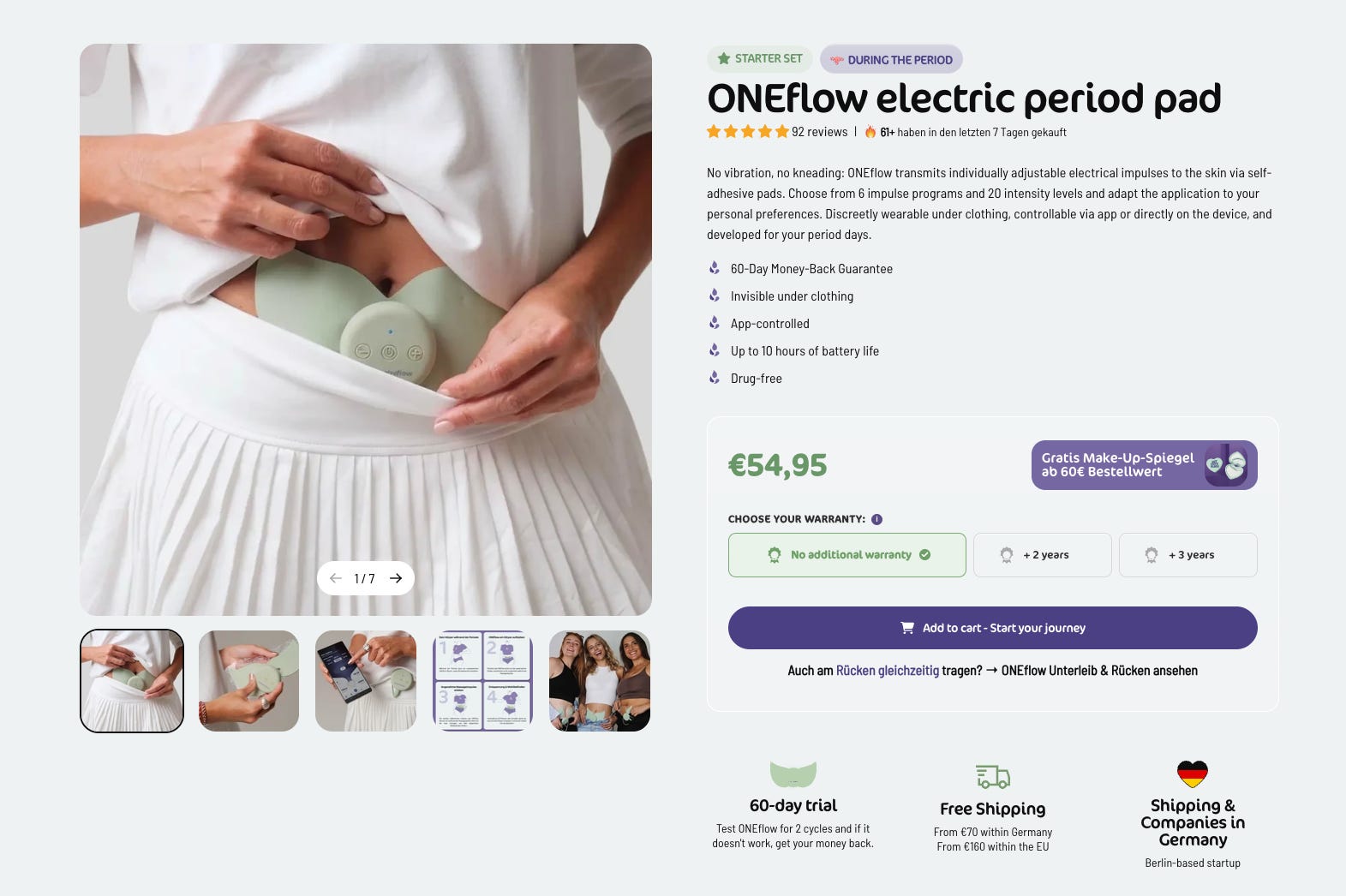
Polina Speidel is a co-founder of menstruflow, based in Berlin. The startup sells ONEflow, an electric period pad, and has more than 15,000 customers. In the first quarter of 2026 it was at times taking 1,000 orders a month, three times as many as the year before. Then, in May, a letter arrived from the authorities, and shortly afterwards menstruflow was completely offline.
This is a summary of Episode 192 of the “Happy Bootstrapping” Podcast (German).
From the sofa to a product in nine months
The idea came up on holiday in January 2023. Polina had suffered from period pain all her life, and doctors had mostly told her that was normal. By April the founding team was at the notary, and in September 2023 the shop went live.
For hardware, that is very fast. It worked because the technology already existed: electrical impulses of the kind used in physiotherapy. A gynaecologist and a designer on the founding team worked out the frequencies and the shape of the pads. Polina contacted around ten manufacturers and soon settled on one.
At the time she was still working full time at a management consultancy. The plan was to run menstruflow on the side. She quit anyway in June 2023, because she had realised how big the taboo around periods still is.
“I want to be the one who breaks the taboo.”
There was no salary for a long time. Polina lived off her savings and her husband’s support. In October 2024 she paid herself a mini-job salary for the first time, and since July 2026 a proper salary. It is still less than she earned as an employee.

One post, 400 orders
From day one, sales came through online marketing, mainly Meta Ads and Google. Launching in September, right before the strongest quarter in e-commerce, was a coincidence. In the first quarter of 2024 orders dried up, and one order a day was worth celebrating. According to Polina, the startup came close to going bust afterwards.
The lever behind the strong first quarter of 2026 was a collaboration with Lisa-Marie Schiffner, who has more than a million followers. Polina did not know when the first post would go out. She watched the visitor count climb in the Shopify live tracker and at first assumed it was a bot. By the end of the weekend there were 400 orders, which she had to pack herself on the Monday.
On the device itself, menstruflow roughly breaks even with campaigns like this. The money is made on the adhesive pads, which customers reorder after about four periods on average.
Until the first quarter of 2026, Polina packed everything herself, in a self-storage unit on her street of barely five square metres. A fulfilment centre in Essen has since taken over.
The letter from the regulator
In May 2026 the state health authority got in touch. The device had been marketed under a term that suggests a medical device, and menstruflow does not have that certification. The deadline: two weeks.
Polina’s first instinct was to call and explain the misunderstanding. Instead she brought in a lawyer specialising in medical device law, and at the end of May the team took everything offline. The lawyer was obliged to brief her on every scenario, including the most unlikely one, which he put at a probability of 0.001 per cent:
“Every sale would have been a criminal offence, and if we’d had more than 15,000 orders, then as managing director I would have committed 15,000 offences.”
It was expensive all the same. The team had just had 6,000 devices produced in advance for the first time, pre-financed with a short-term loan, and the old term was printed on every box. Luckily the devices were still with the manufacturer. The packaging was reprinted, and menstruflow now takes delivery of the stock bit by bit over several months.
menstruflow has been back online since July 2026. Meta Ads are on hold because the pixel is blocked. Orders are currently at around 300 a month, about half of them from returning customers. Besides the company’s own shop, ONEflow is available at dm and DocMorris, and Amazon is being added.
The certification itself is planned for 2027. The consultants’ estimates range from 30,000 to 500,000 euros.
When do you pull the plug?
After the letter in May, Polina reached the point where she wanted to stop. Her husband asked her to give it one more try, pointing to the strong first quarter:
“We do have a certain proof of concept now.”
The goal is to be back at the old level by Q1 2027. What happens if that does not work out, she leaves open, and asks herself: “And when do you make the hard cut?”
What I learned in the interview
One word on the packaging can be enough. menstruflow named the device after the technology it uses. That was enough to take the company offline for weeks and reprint 6,000 boxes.
Hardware ties up money in the wrong place. The largest production run landed in exactly the months when nothing could be sold. The manufacturer agreeing to spread out the deliveries saved the startup.
The certification waits until 2027. It is unresolved and expensive, and the team wants to grow again first:
“If we’ve learned anything in these three and a half years, it’s to really focus and tick off one topic after another.”
Full Episode on YouTube (German)
Learnings for founders
Have product names and taglines checked legally before printing, not afterwards.
When the authorities write, talk to a specialist lawyer before you respond.
Smaller production runs keep capital free and give you flexibility.
Consumables like pads turn a one-off device into recurring revenue.
Agree in advance when an influencer will post.
In e-commerce, Q4 is no benchmark for Q1.
Happy Bootstrapping is a German podcast where I interview bootstrapped founders, indie hackers, and solopreneurs about their startup journeys.
Over the years, I’ve connected with many successful entrepreneurs who have built e-commerce shops, SaaS platforms, mobile apps, content businesses, or hybrid models.
Furthermore I am a bootstrapper myself and growing my DevOps-as-a-Service and Web Operations Company “We Manage”.