

Marten Pieper founded and runs re:fund, a tech-enabled public funding consultancy with eight people in Berlin and Hamburg. More than 150 clients, over 200 projects and upwards of 100 million euros secured for those clients – built without investors, billed strictly on success.
This is a summary of Episode 189 of the “Happy Bootstrapping” Podcast (German).
From legal tech to innovation funding
Marten started in 2021 with Lexup GmbH and LexHub, a platform to make legal services accessible to small teams. Within months the three founders turned out to want different things, above all on venture capital. Marten was against it, ended up alone and decided to bootstrap.
The pivot came later that year, triggered by an operational problem. Nothing tells you from the outside when a company needs a legal service. With public funding, plenty does: patent databases and visible development work let Marten identify candidates instead of waiting for enquiries.
“re:fund stands for reinvent funding.”
What actually counts as innovation
Plenty of founders skip the topic because they confuse innovation with fundamental research. Germany’s R&D tax credit, the Forschungszulage, asks for less. Three criteria: novelty as a departure from the state of the art, a scientific or technical uncertainty, and a documented plan of development steps.
“You don’t have to create a radical innovation – an incremental departure from the state of the art can be enough.”
The type of risk matters. Whether customers will buy is commercial and doesn’t count. Whether a technical approach works at all does, if described concretely, with quantifiable challenges and stop criteria.
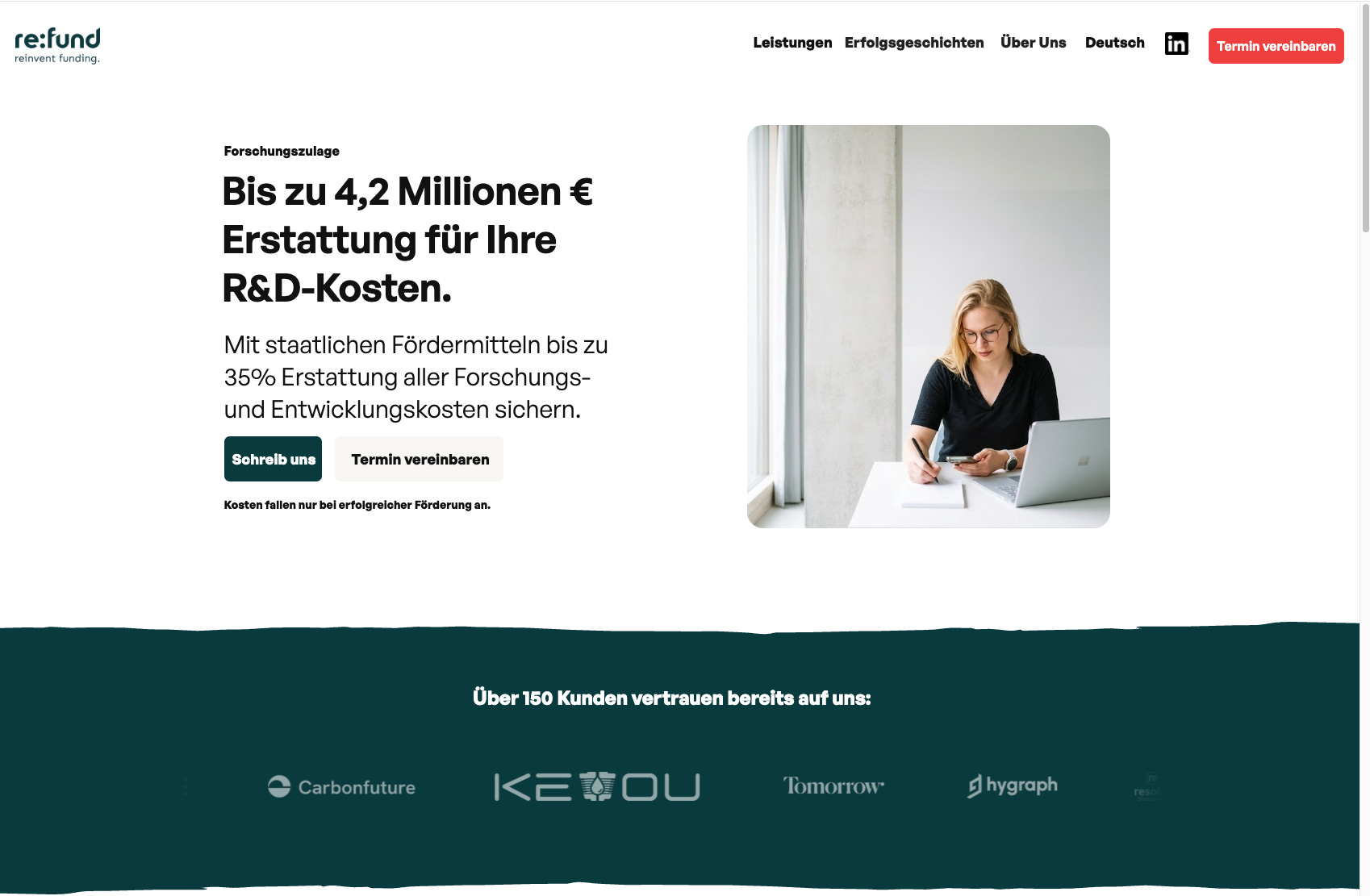
The scheme works retroactively: the law came into force in 2020 and costs can be claimed four years back, so re:fund usually starts in a company’s past.
Half an hour of screening instead of an online form
Around 95 per cent of the applications re:fund submits are approved. That rate is created before the application, not in it. They call it strategic application planning: sign an NDA, spend half an hour in the development work together, assess the potential and whether the effort is worthwhile. Only then comes a project contract. They happen even when there isn’t enough in it for either side, often ending with a recommendation for a different programme.

Paid on success means doing the work first
re:fund is paid a share of what reaches the client, and only once it has arrived. Submit, wait up to three months for the certifying body, build the documentation, file the costs with the tax office, wait for the tax assessment. Only then does the invoice go out.
“We want to work on a success basis, because that puts us fully in the same boat.”
For a bootstrapper that is brutal. Marten won clients, delivered projects and still couldn’t invoice for a long stretch. He paid himself nothing at first, later minimum wage. His COO, Elisabeth Teske, could only be hired more than a year after the pivot.
“had no revenue at all for a long time”
How to spot a good funding adviser
One point Marten makes repeatedly: the market is unregulated.
“It’s neither a protected profession nor a protected term in that sense.”
His criteria are concrete. First, the background of the person doing the work, not the size of the firm. Second, the fee model – anyone earning on costs claimed rather than on the payout has an incentive to inflate positions that get struck out under audit. Third, the scope: many advisers only handle the certification and leave documentation and the cost claim to the client. That is where the risk sits, because the phase one estimate is not enough for phase two.
Crisis-proof is relative
ZIM, for years the most commonly used innovation programme, was paused without warning. The Forschungszulage, by contrast, has been expanded rather than cut by every government so far. The familiar complaint that Germany funds too little and makes it too complicated he only half shares: the burden of proof here stops every marketing agency from declaring itself an innovator.
“So I think it’s a reasonable middle ground.”
The exit he never planned
re:fund was approached several times, initially without interest. At some point the question shifted from whether they could imagine it to what it would make possible. What decided it was not the highest offer but the partner who promised they could carry on independently.
“you can keep going as a speedboat”
The hardest phase wasn’t building the company, but the months before the signature. Marten is open about having sought support during that time.
“It was never the feeling of jumping for joy.”
What I learned in this interview
Public funding is the cheapest financing available to a bootstrapper and still the least used. Not because the money is scarce, but because the barrier feels higher than it is.
A success fee is a promise to the client and an imposition on the provider: he finances the lead time himself and grows more slowly than he could.
The hardest part of an exit often comes before the signature – not in letting go afterwards, but in the months of running the company alongside the process.
The full interview on YouTube (German):
Learnings for founders
Don’t rule yourself out – an incremental departure from the state of the art is enough for the R&D tax credit.
Check your adviser’s fee model. Earning on the costs claimed rather than on the payout is the wrong incentive.
Get the whole route committed to, not just the application. Documentation and the cost claim decide whether the money survives an audit.
Budget for the lead time on success fees – twelve months between engagement and invoice is easily possible.
You only keep the company running as long as you keep yourself running. Marten described that as his limit.
Happy Bootstrapping is a German podcast where I interview bootstrapped founders, indie hackers, and solopreneurs about their startup journeys.
Over the years, I’ve connected with many successful entrepreneurs who have built e-commerce shops, SaaS platforms, mobile apps, content businesses, or hybrid models.
Furthermore I am a bootstrapper myself and growing my DevOps-as-a-Service and Web Operations Company “We Manage”.