

Johannes is the founder of Duschbrocken for seven and a half years – a D2C brand for plastic-free care. What started as solid shampoo and shower gel in one has become a mission: making the entire daily care routine plastic-free. Without a wagging finger, but with fun and conviction.
Completely bootstrapped, profitable, and with an advent calendar that’s already 85 percent sold out in November. How did he achieve this? A story about persistence, community building, and the courage to go your own way.
This is a summary of Episode 146 of the “Happy Bootstrapping” Podcast (German).
The Founding Story: From Idea to Brand
Seven and a half years ago, Johannes started with his co-founder with a simple idea: combine solid shampoo and shower gel in one product. The Duschbrocken (shower chunk) was born – a compact, plastic-free care product that saves space and protects the environment. “We want to make the entire daily care routine plastic-free,” Johannes explains the vision. “But not with a wagging finger, rather through performance and fun.”
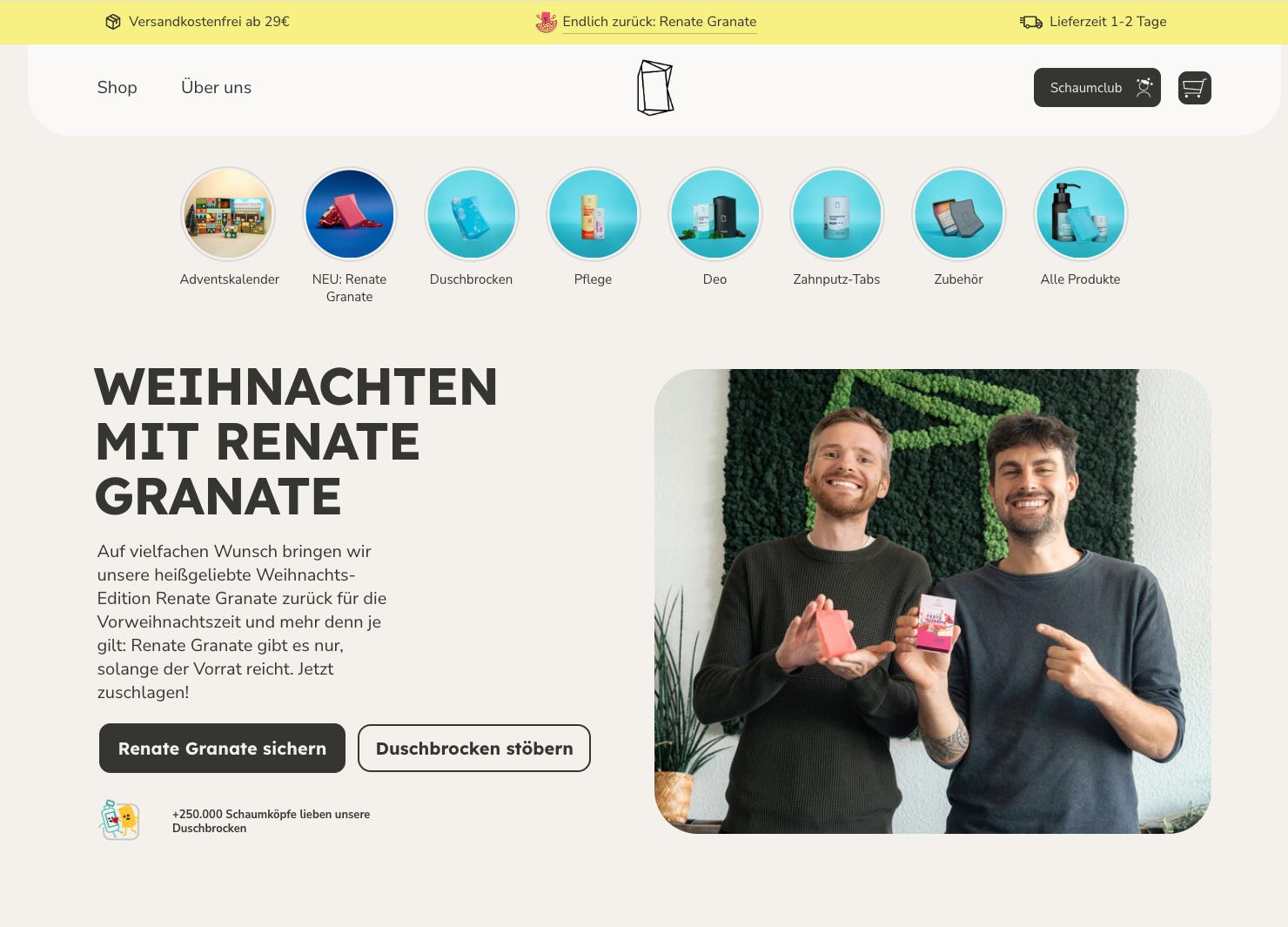
The early days were characterized by experimentation and learning. Johannes and his co-founder built the company without external investors, focused on direct-to-consumer via duschbrocken.de from the start, and concentrated on making sustainable consumer decisions attractive. “We’re not changing the world with Duschbrocken,” Johannes admits realistically. “But we want to make an impact and have fun doing it.”
What started with a single product is now a broad range. Duschbrocken now offers the entire spectrum for plastic-free care – from the original Duschbrocken to facial care to seasonal products. The biggest development? The advent calendar, which became an absolute game changer.
The Product and Business Model: Advent Calendar as Revenue Driver
Duschbrocken relies on a classic D2C model: products are sold directly through their own website. The original product – solid shampoo and shower gel combined – forms the foundation. But the real star is the advent calendar. For four years, Duschbrocken has released an advent calendar every year, and the launch timing is unusual: August 31st.
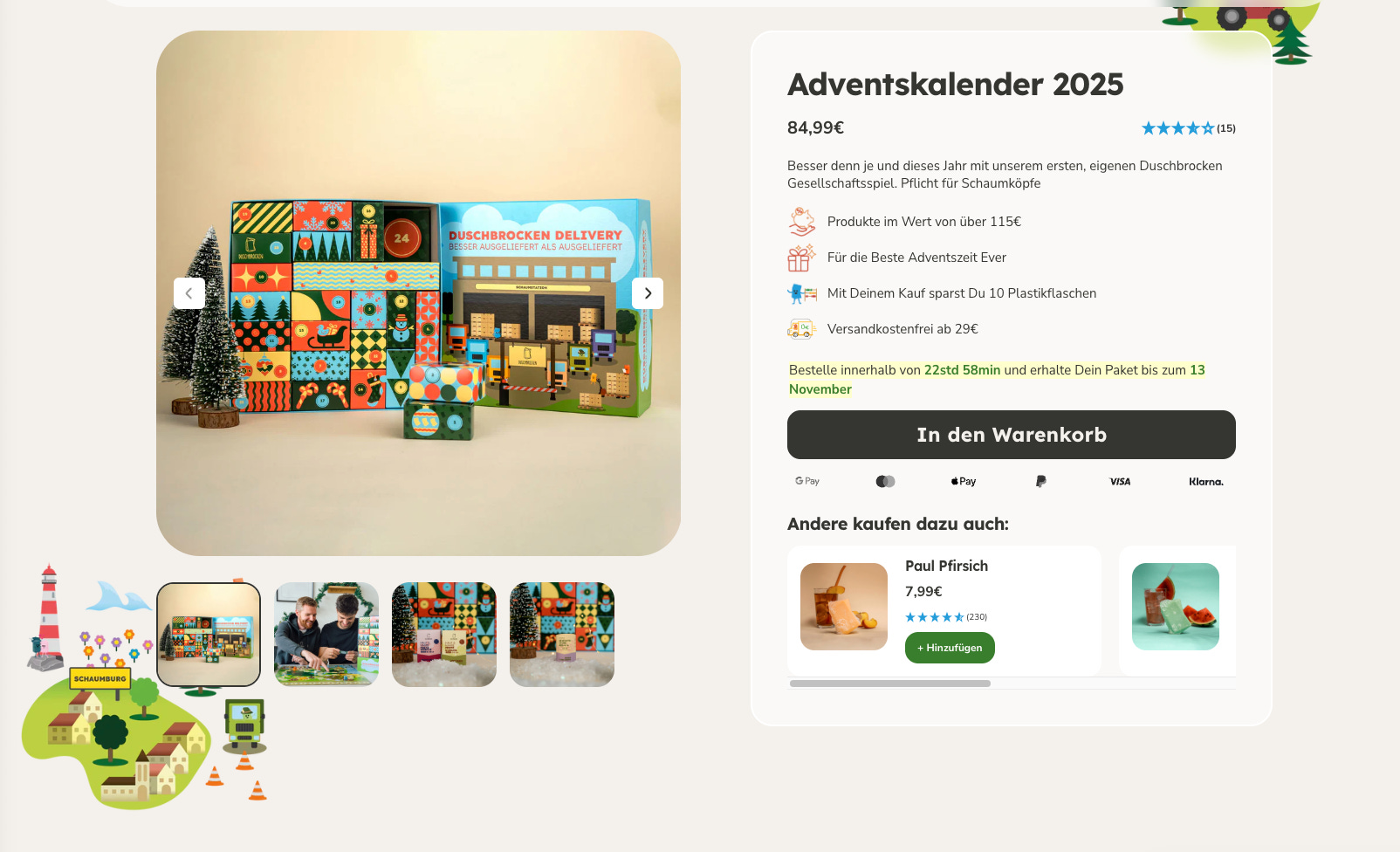
“We always try to have our advent calendar live a week before gingerbread appears in supermarkets,” Johannes explains the strategy. And it works: by early November, 85 percent of the advent calendar is already sold. The team is even considering moving the launch to July – demand is enormous.
The advent calendar isn’t just a seasonal product, but a strategic workhorse. It retains existing customers, brings in new customers, and provides a massive revenue boost in the fourth quarter.
“Imagine you buy an advent calendar and it’s already sold out by the end of October,”
Johannes describes the problem that Duschbrocken solves with the early launch. The company is profitable and has built a loyal community over the years that waits for new products – and buys them.
Marketing: Community, Content, and Authenticity
Duschbrocken’s marketing is based on three pillars: authenticity, community, and content. Johannes doesn’t rely on aggressive ads or glossy campaigns, but on honest communication and genuine conviction. “We want to convince people through our performance and fun to make more sustainable consumer decisions,” he describes the approach.
The community plays a central role. Over the years, Duschbrocken has built a loyal fan base that not only buys but also recommends. The advent calendar works so well mainly because the community loves it and eagerly waits every year. “It feels like it’s getting earlier every year,” Johannes laughs about the launch timing – but customers accept it.
Content is the second pillar. Duschbrocken relies on social media, newsletters, and a strong presence on their own website. The message is clear: sustainability can be fun. Instead of working with guilt feelings, Johannes shows that plastic-free care is practical, stylish, and easy to implement. The brand positions itself as a lifestyle brand, not an eco-moralist.
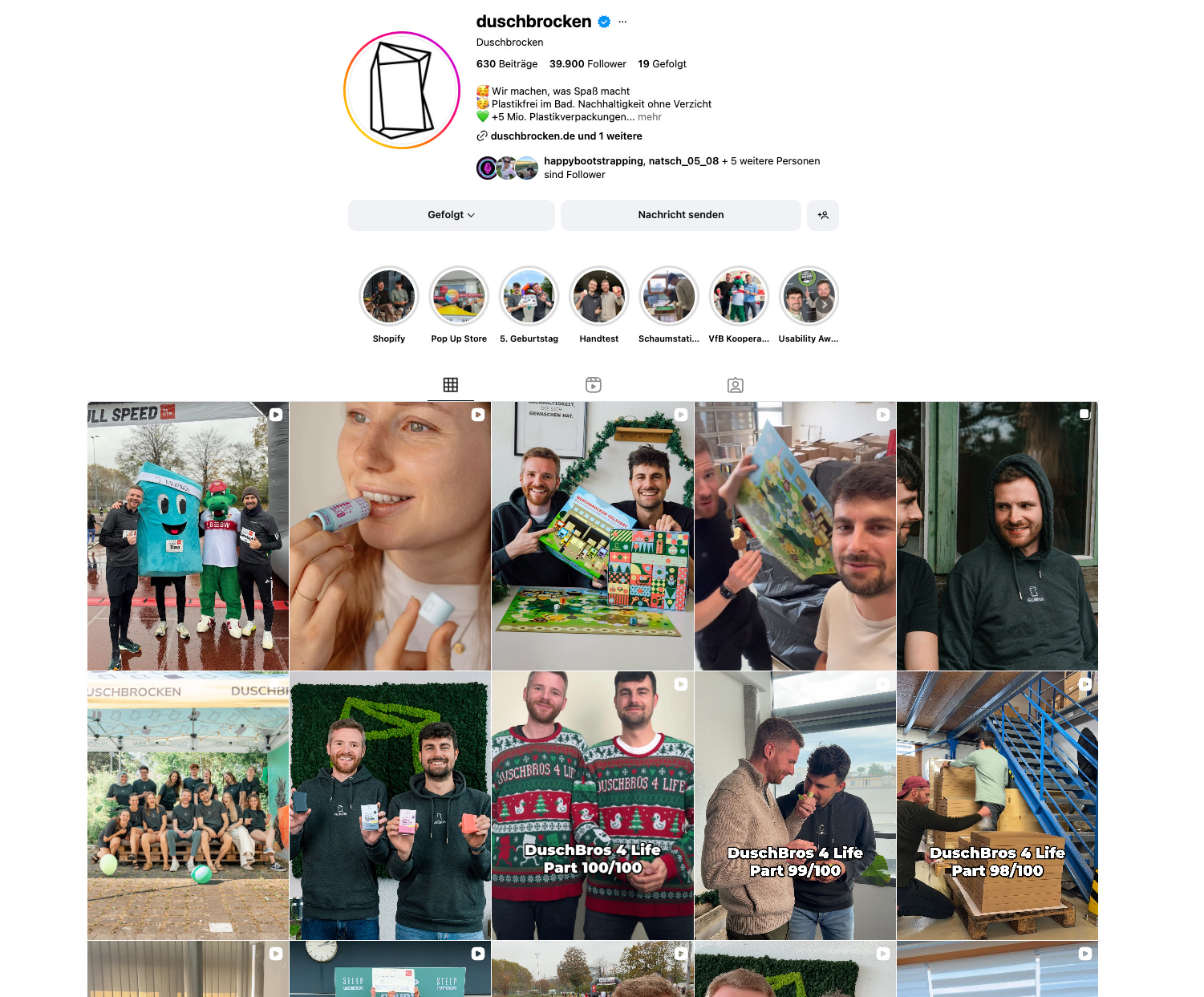
Paid ads play a role, but not the main role. Johannes focuses on organic growth, word-of-mouth, and targeted campaigns at specific times – like the advent calendar launch. The mix works: Duschbrocken grows steadily and profitably without being dependent on investors.
Technology and Team: Lean, Efficient, Bootstrapped
Duschbrocken uses a lean tech stack: the website runs on a classic e-commerce platform optimized for conversion and user experience. Johannes and his team have learned over the years what works – from product presentation to checkout optimization.
The team has changed significantly since the early days. Johannes talks about team dynamics that have grown but also brought challenges. “It’s always the question of what you measure success by,” he says about success and growth. Duschbrocken relies on a small but efficient team that lives and communicates the brand’s values.
Production is outsourced, fulfillment as well. Duschbrocken focuses on what really matters: product development, marketing, and community building. This makes the company flexible and scalable – without the fixed costs of a large team or own production facilities.
Bootstrapping Challenges: Patience, Focus, and Realistic Expectations
The biggest bootstrapping challenge? Patience. Duschbrocken isn’t a rocket ship, but a marathon. “We’re not changing the world with Duschbrocken,” Johannes admits openly. But that’s not the goal either. The goal is to build a profitable, sustainable business that makes an impact and is fun.
The second challenge is focus. The startup scene often talks about unicorns and hypergrowth.
“I’m a bit worried that people are afraid and think: Oh, my idea of opening a coffee shop is so small, I can’t achieve anything with that” ,
Johannes describes his observation. Duschbrocken is the counterexample: a business that doesn’t focus on rapid growth at any cost, but on sustainable development.
The third challenge is expectations. “The Gorillas founder was the most celebrated founder ever for a long time,” Johannes recalls. “Nobody became a unicorn faster than Gorillas – and nobody went in the other direction so fast.” Duschbrocken measures success differently: by profitability, team satisfaction, and impact.
We recorded the podcast at Heilbronn Slush’d 2025 from inside an Audi S1 e-tron quattro Hoonitron. Attendees could listen to the podcast “live” with headphones. Here are some pictures of the event:


What I Learned from the Interview:
Consistency beats hype: Duschbrocken has been on the market for 7.5 years – without venture capital, without exit pressure. Slow, steady growth can be more successful than rapid burnout.
Seasonal products as revenue drivers: The advent calendar isn’t just a nice-to-have, but a strategic product that creates loyalty and generates massive revenue.
Authenticity over perfection: Duschbrocken doesn’t sell perfection, but an attitude. Sustainability with a fun factor works better than moral preaching.
Learnings for Bootstrappers:
Start small, think big: Johannes started with one product and expanded step by step. Not every idea has to be a rocket – a coffee shop can be just as fulfilling and successful.
Take seasonal products seriously: The advent calendar shows that seasonal products can be massive revenue drivers. An early launch (August 31st!) secures attention and sales.
Bootstrapping requires patience: 7.5 years is a long time. But it enables sustainable growth without exit pressure or investor expectations.
Community is everything: Loyal customers buy again – and recommend. Duschbrocken thrives on its community, not ads.
Success is relative: Not every startup has to become a unicorn. Profitability, satisfaction, and impact are valid metrics for success.
Focus on fun: “We want to convince through performance and fun.” Those who have fun stick around – as founders and as customers.
Happy Bootstrapping is a German podcast where I interview bootstrapped founders, indie hackers, and solopreneurs about their startup journeys.
Over the years, I’ve connected with many successful entrepreneurs who have built e-commerce shops, SaaS platforms, mobile apps, content businesses, or hybrid models.
Furthermore I am a bootstrapper myself and growing my DevOps-as-a-Sercice and Web Operations Company “We Manage”.